Writing11 min readShakhawat
AI Agent vs Chatbot: What Is the Difference in 2026?
AI agent vs chatbot, plus assistants and agentic workflows: a 10-point comparison table, one worked example and a decision path for choosing the right one.
- Automate
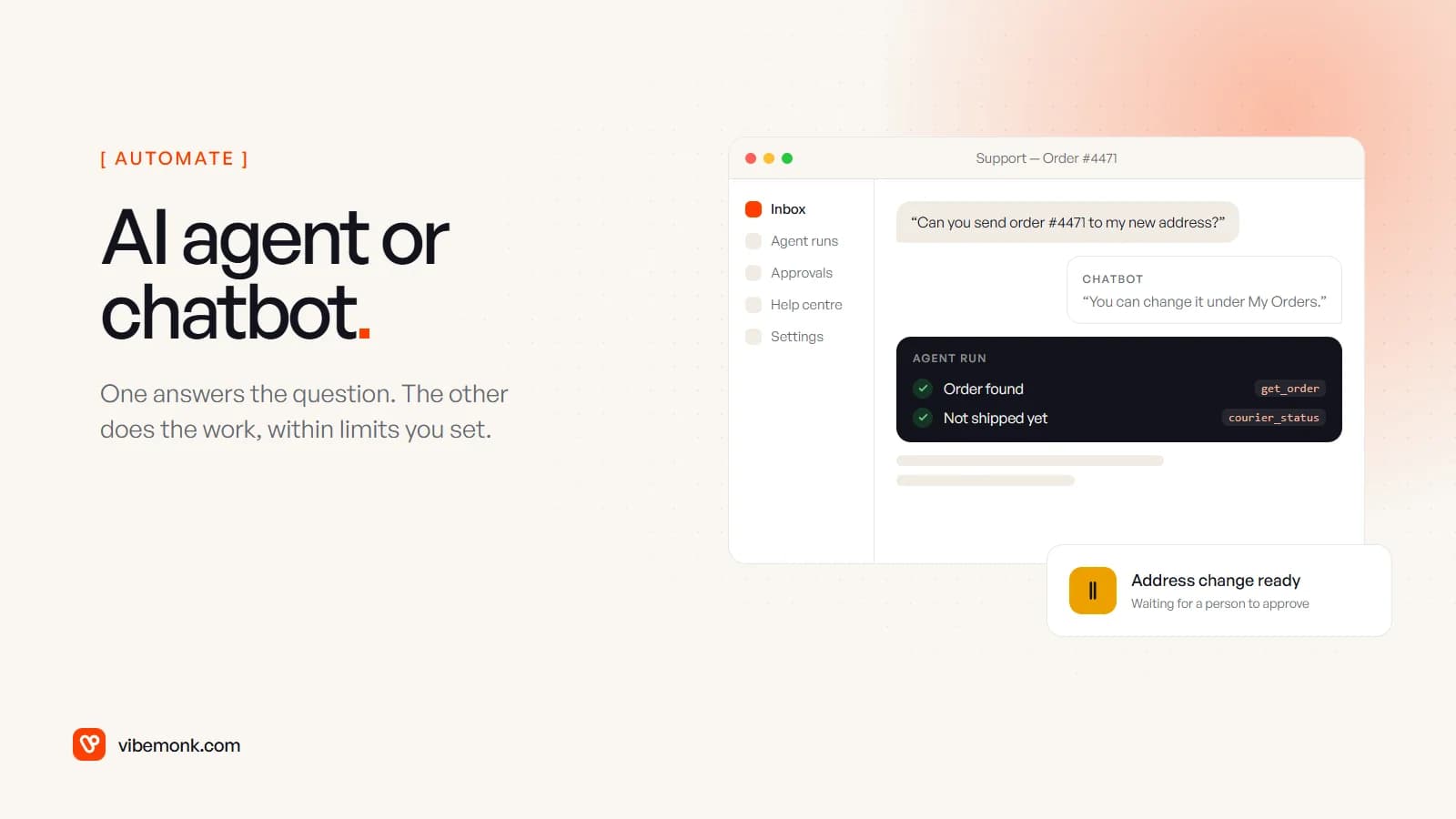
The short answer to AI agent vs chatbot: a chatbot answers, an agent acts. A chatbot takes a message and returns a reply, usually from your help content. An AI agent takes a goal, decides which steps to take, calls tools in your systems to take them, and checks the result before it moves on. Between the two sit the AI assistant, which drafts while a person stays in charge, and the agentic workflow, where your code fixes the steps and the model handles the judgement inside them.
None of these is the "advanced" version of the others. Each fits a different kind of job, and the most autonomous option is also the most expensive one to run, test and trust. Below are the four definitions, a side-by-side table, one customer request handled both ways, and a decision path you can run against your own process.
Chatbot, assistant, agentic workflow, agent: four definitions
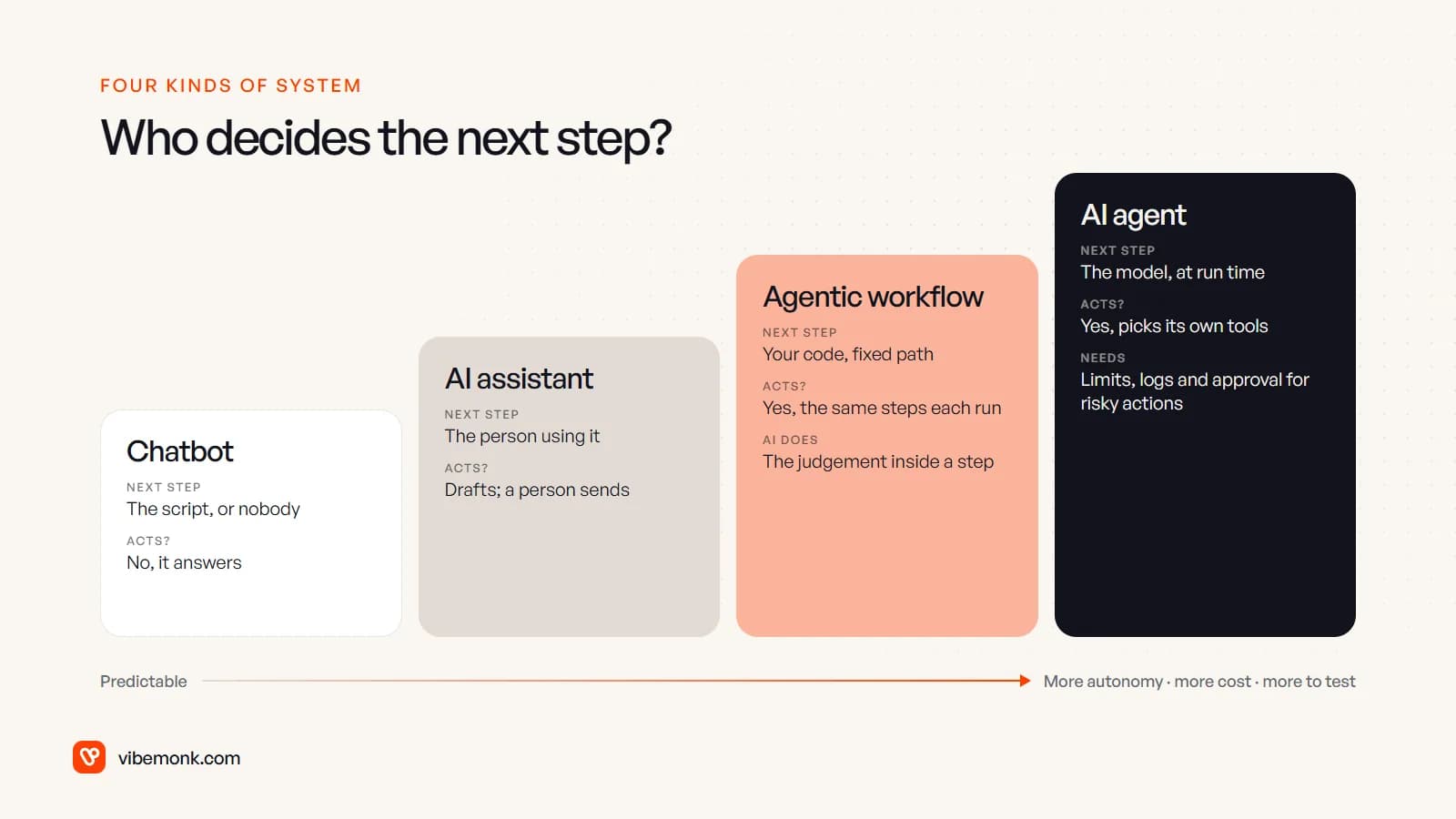
The clearest test is a single question: who decides the next step? Everything else, from cost to risk, follows from the answer.
Chatbot
A chatbot is a conversational interface that returns a response to each message. Older ones followed scripted decision trees; current ones use a language model, often with retrieval from your documents so the answers come from your own content. What makes it a chatbot is that it does not change anything outside the conversation. It can tell a customer how to request a refund. It cannot issue one.
OpenAI's own practical guide to building agents draws the line in the same place: applications that integrate a model "but don't use them to control workflow execution — think simple chatbots, single-turn LLMs, or sentiment classifiers — are not agents."
AI assistant
An AI assistant works alongside a person. It drafts the email, summarises the call, suggests the next reply in the help desk. It may read from several systems, but the person decides what happens with the output. That human checkpoint on every action is what keeps an assistant low-risk, and also what caps how much work it takes off anyone's plate.
Agentic workflow
An agentic workflow is ordinary automation with a model inside some of its steps. The path is fixed in code: an invoice arrives, the model extracts the fields, a rule checks them against the purchase order, the record is created, exceptions go to a person. The model does the reading and judging; it never chooses the route.
Anthropic's engineering team uses this split in Building effective agents: workflows are "systems where LLMs and tools are orchestrated through predefined code paths", while agents are "systems where LLMs dynamically direct their own processes and tool usage". Most of what businesses need sits on the workflow side of that line.
AI agent
An AI agent is given a goal and a set of tools, and the model decides at run time which tool to call, in what order, and when the job is done. OpenAI's guide describes agents as "systems that independently accomplish tasks on your behalf", with the model managing the workflow, picking tools by the current state, and handing control back to a person when it fails. That flexibility is what an agent buys you. It is also what makes it harder to predict.
AI agent vs chatbot: the side-by-side comparison
The table compares all four across the ten points that matter when you are deciding what to build. Read it by row, not by column: the question is which trade-off your process can live with.
| Chatbot | AI assistant | Agentic workflow | AI agent | |
|---|---|---|---|---|
| Input | A message in a chat window | A request from a person, plus the document or record they are on | An event: a form, an email, a new row, a schedule | A goal, from a person or an event |
| Reasoning | Picks the best answer to this message | Works on the one task it was asked to do | Judges within a step (classify, extract, draft); the path is fixed | Plans the steps, reviews each result, re-plans |
| Tool use | Usually none beyond searching your content | Reads from a few systems; writes only as drafts | Calls the tools your code calls, in the order it calls them | Chooses among the tools you expose |
| Memory and context | The conversation, plus retrieved documents | The current task and what the person shows it | State held by the workflow (record IDs, step results) | The run so far, tool results, sometimes saved notes per customer or account |
| Actions | None outside the chat | Drafts; a person sends or saves | Creates and updates records, sends messages | Creates, updates, sends, and decides which of those to do |
| Autonomy | None | Low: one step at a time | Medium: runs alone on a known path | High: chooses the path |
| Human approval | Hand-off to a person when it cannot answer | Built in: a person acts on every output | At set points, usually on exceptions | Needed on risky actions until it has earned trust |
| Best use cases | FAQs, policy and product questions, routing to the right team | Writing, summaries, research inside the tools staff use | Document intake, lead routing, CRM updates, reports | Requests that vary case by case and need several systems |
| Complexity | Low | Low to medium | Medium | High: tool design, permissions, testing, monitoring |
| Cost considerations | One model call per message | Per seat or per request | Model calls only in the AI steps; predictable per run | Several model calls per task, varying run to run, plus build and testing time |
Two rows deserve a closer look. Human approval is not a weakness of the agent column; it is how a sensible agent ships. OpenAI's guide recommends human oversight for "actions that are sensitive, irreversible, or have high stakes", with refunds and payments as its examples, "until confidence in the agent's reliability grows". And cost is where the columns diverge most in practice, which is the next section.
The same customer request, handled two ways
Take one message to a delivery company's support channel: "I moved last week. Can you send order #4471 to my new address?" This is a worked example, not a client case, but the shape is typical of support work.
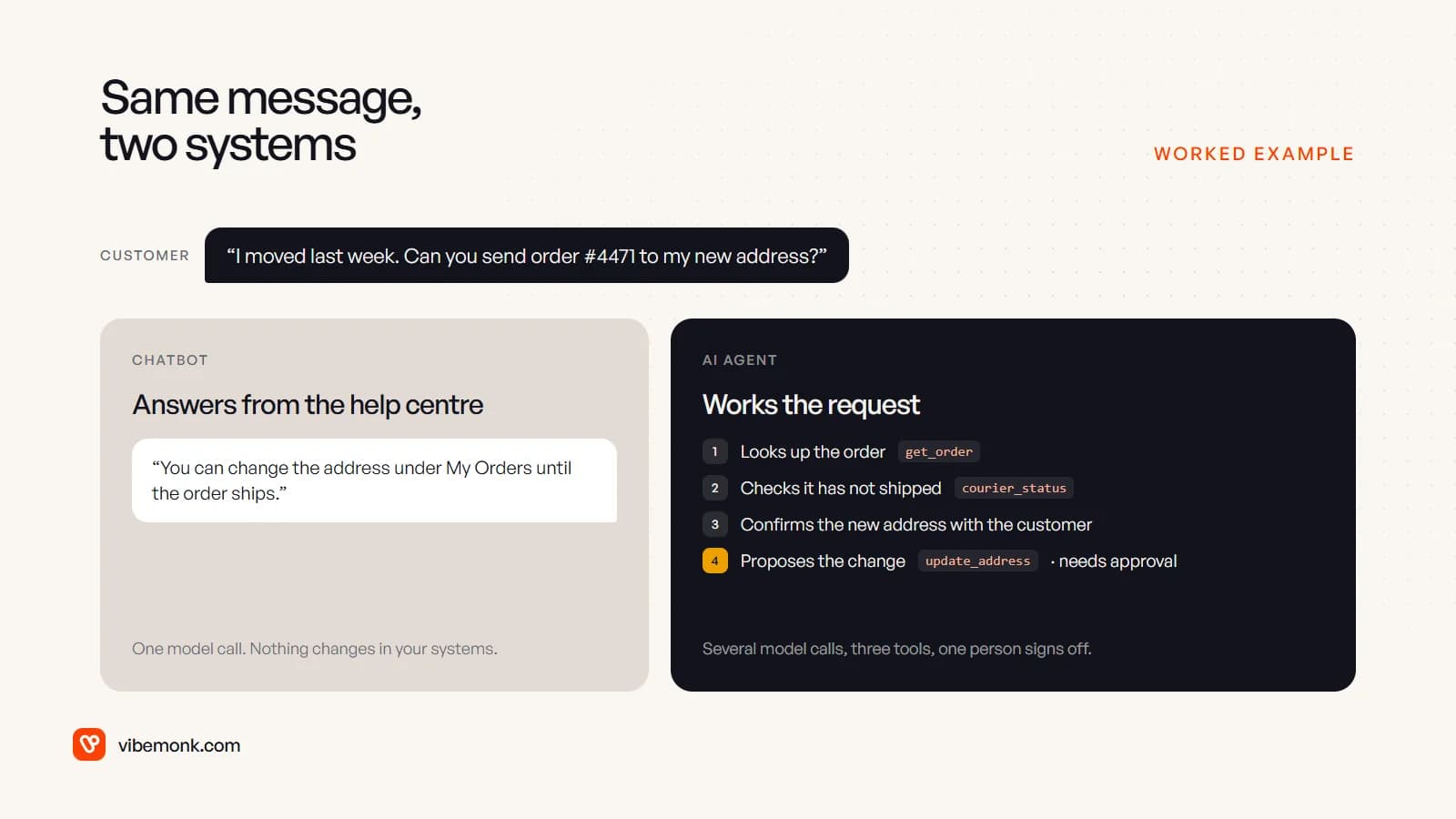
The chatbot finds the help-centre article and replies that the address can be changed under My Orders until the order ships. That is accurate, cheap and fast. The customer still has to do the work, and if the order has already left the warehouse, the answer is unhelpful.
The agent looks the order up, checks the courier status, confirms the new address with the customer, and prepares the change. Because changing a delivery address can go wrong in ways that cost money, the last step waits for a person to approve it. The customer gets the outcome, not instructions.
An agentic workflow could handle this too, if address changes are common enough to be worth a fixed path: look up order, check status, update or escalate. No model needs to decide the order of steps, because the steps never change. The model's job would be reading the message and pulling out the order number and the address. That is usually the version to try first: it is easier to test and cheaper to run.
The agent earns its place when the requests vary: one customer wants an address change, the next wants to split a shipment, the next has a damaged item and a question about the invoice. Writing a fixed path for every combination stops being practical, which is the point OpenAI's guide makes when it says agents suit workflows with "complex decision-making", "difficult-to-maintain rules" or "heavy reliance on unstructured data".
What an agent costs that a chatbot does not
An agent is not a chatbot with extra features. It is a different kind of system with different running costs and failure modes.
More model calls per task. A chatbot reply is usually one call. An agent plans, calls a tool, reads the result, decides again, and repeats until it is done, so one request can mean many calls, and the number changes from run to run. Anthropic's team puts the trade-off plainly: agentic systems "often trade latency and cost for better task performance", and for many applications "optimizing single LLM calls with retrieval and in-context examples is usually enough".
Tools that need designing. Every action an agent can take is a tool you write, with its own permissions. update_address needs to know which orders it may touch, what to validate, and what to log. That is integration work, and it is most of the build. It is the same work as in any integration between your systems, with a model choosing when to call it.
Testing that never quite finishes. A fixed workflow can be tested path by path. An agent can take paths you did not write down, so it needs test scenarios, logs of every run, and limits on retries and spend. Anthropic recommends "extensive testing in sandboxed environments, along with the appropriate guardrails".
The answers are still yours. A chatbot is not a safe default just because it cannot act. In Moffatt v. Air Canada (2024 BCCRT 149), the airline's website chatbot told a customer he could apply for a bereavement fare after travel, which was not the airline's policy. The tribunal rejected the airline's argument that the chatbot was a separate entity responsible for its own actions, and held the airline liable for what it said. Whatever you put in front of customers, ground it in your real policies and give it a clear route to a person.
The market adds one more caution. Gartner predicted in June 2025 that over 40% of agentic AI projects will be cancelled by the end of 2027, citing escalating costs, unclear business value and inadequate risk controls. The same release describes "agent washing": assistants, chatbots and RPA tools rebranded as agents without real agentic capability. When a vendor says "agent", ask what it can actually do in your systems without a person clicking.
When a chatbot is the better choice
Choose a chatbot when the job is answering, and the answers live in content you control:
- Customers ask the same product, pricing-policy or how-to questions over and over.
- Your help centre or internal handbook is good, but people do not search it.
- The cost of a wrong answer is a follow-up message, not a lost order. Even then, the Air Canada case shows the answers must match your actual policies.
A chatbot is the wrong choice when the honest reply to most messages is "someone will look into it". If the work starts after the conversation ends, a better chat window will not remove it.
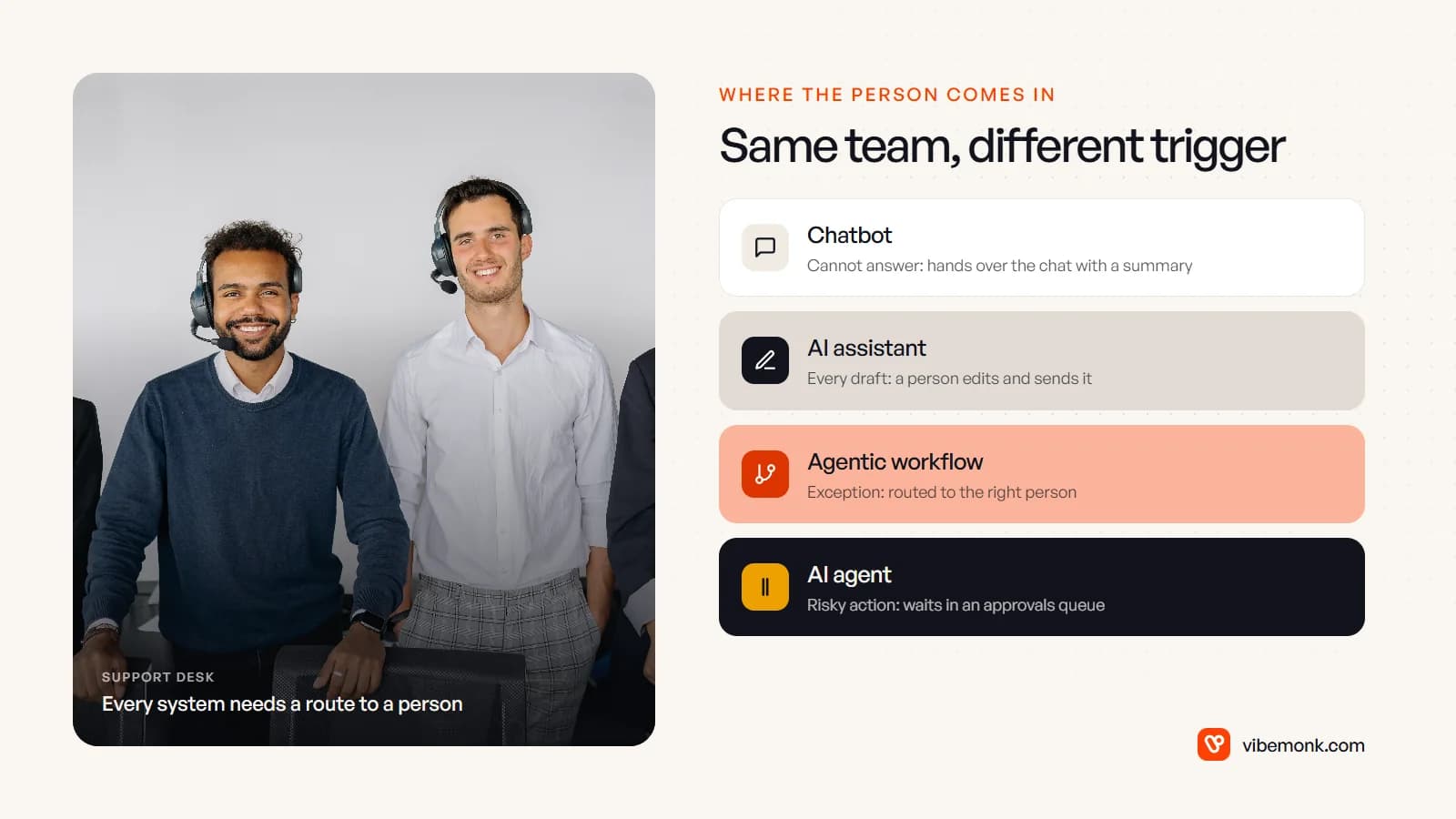
Whichever you choose, the support team does not disappear; what changes is the moment they step in.
When you need an AI agent, and when a workflow is enough
Choose an AI agent when all three of these hold:
- The work requires action in your systems: updating records, sending messages, booking, refunding.
- The path varies case by case, so a fixed sequence would need dozens of branches.
- Mistakes can be caught, because risky actions wait for approval or can be reversed.
If the first holds but the second does not, you want an agentic workflow, not an agent. Most invoice processing, lead routing and CRM updating falls here: messy inputs, predictable steps. If the third does not hold, keep a person on the task until it does. Approval gates are cheap to build and they are how an agent earns the right to do more.
Approval is not a theoretical extra. In uContents, the social publishing platform we built, the studio agent works with tools, skills and a memory per brand, and asks for approval before anything that costs credits or changes data. Its MCP server goes further: anything that writes is proposed first and has to be confirmed within fifteen minutes.
A decision path you can use this week
Pick one process that costs your team time, and walk it through these four questions in order. Stop at the first "yes".
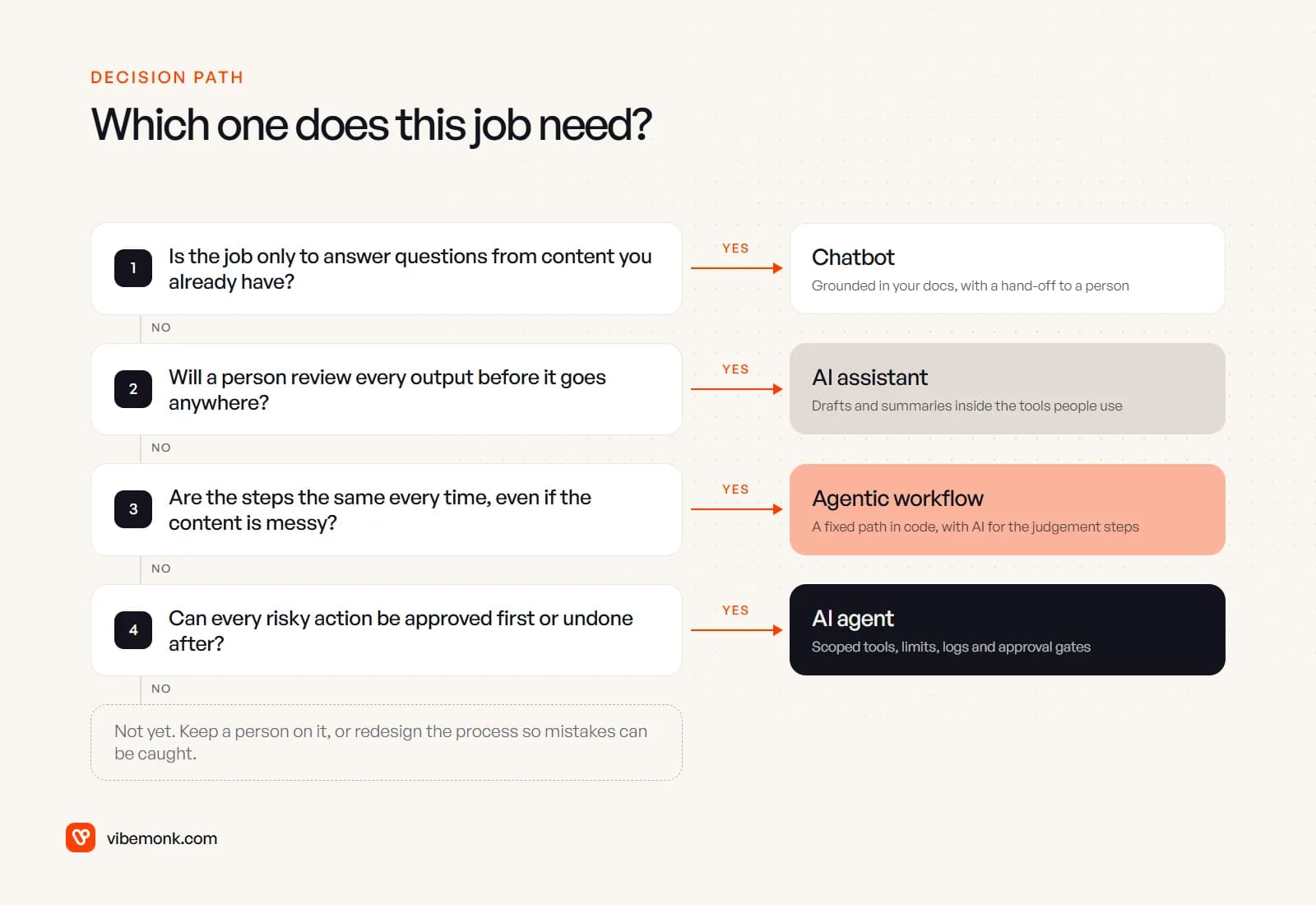
- Is the job only to answer questions from content you already have? Build a chatbot, grounded in your documents, with a hand-off to a person.
- Will a person review every output before it goes anywhere? Give them an AI assistant inside the tools they already use.
- Are the steps the same every time, even if the content is messy? Build an agentic workflow: a fixed path in code, with the model doing the reading and drafting.
- Can every risky action be approved first or undone after? Build an AI agent, with scoped tools, spending and retry limits, run logs and approval gates.
If you answer "no" to all four, the process is not ready for any of them yet. Redesign it so mistakes can be caught, then ask again.
Most businesses end up with more than one of these. A chatbot answers the common questions, a workflow handles the predictable back-office steps, and an agent takes the varied requests the other two cannot. The useful question is never "chatbot or agent" in general; it is which one this particular process needs.
Questions people also ask
Can a chatbot be turned into an AI agent? Partly. The conversation layer can stay, but the agent part is new work: tools that read and write your systems, permissions for each, approval steps and run logs. The model is the smaller part of the job.
Is an AI agent the same as an autonomous AI agent? "Autonomous" describes how much the agent may do without asking. Fully autonomous agents that act with no approvals suit low-risk, reversible tasks. For anything involving money, customer data or commitments, the sensible default is an agent that proposes and a person who approves.
Are agents more accurate than chatbots? Not by default. They use the same models. An agent can check its work with tools, which helps, but every extra step is another place to go wrong. Accuracy comes from grounding, testing and limits, not from the label.
Where to start
Write down the one process you would most like off your team's plate, and run it through the four questions. If the answer is a workflow or an agent, our AI agents and workflow automation page shows what that build involves. If you are not sure which process to start with, or the answer is "not yet", a short discovery and scoping session is the cheaper first step: it finds the process worth automating and the version of it worth building.