Writing10 min readRh Razu
Automation Agency Pricing: What You Are Paying For
Automation agency pricing explained: fixed, hourly, retainer and per-workflow models, who carries the risk in each, what a quote must list, and the red flags.
- Grow
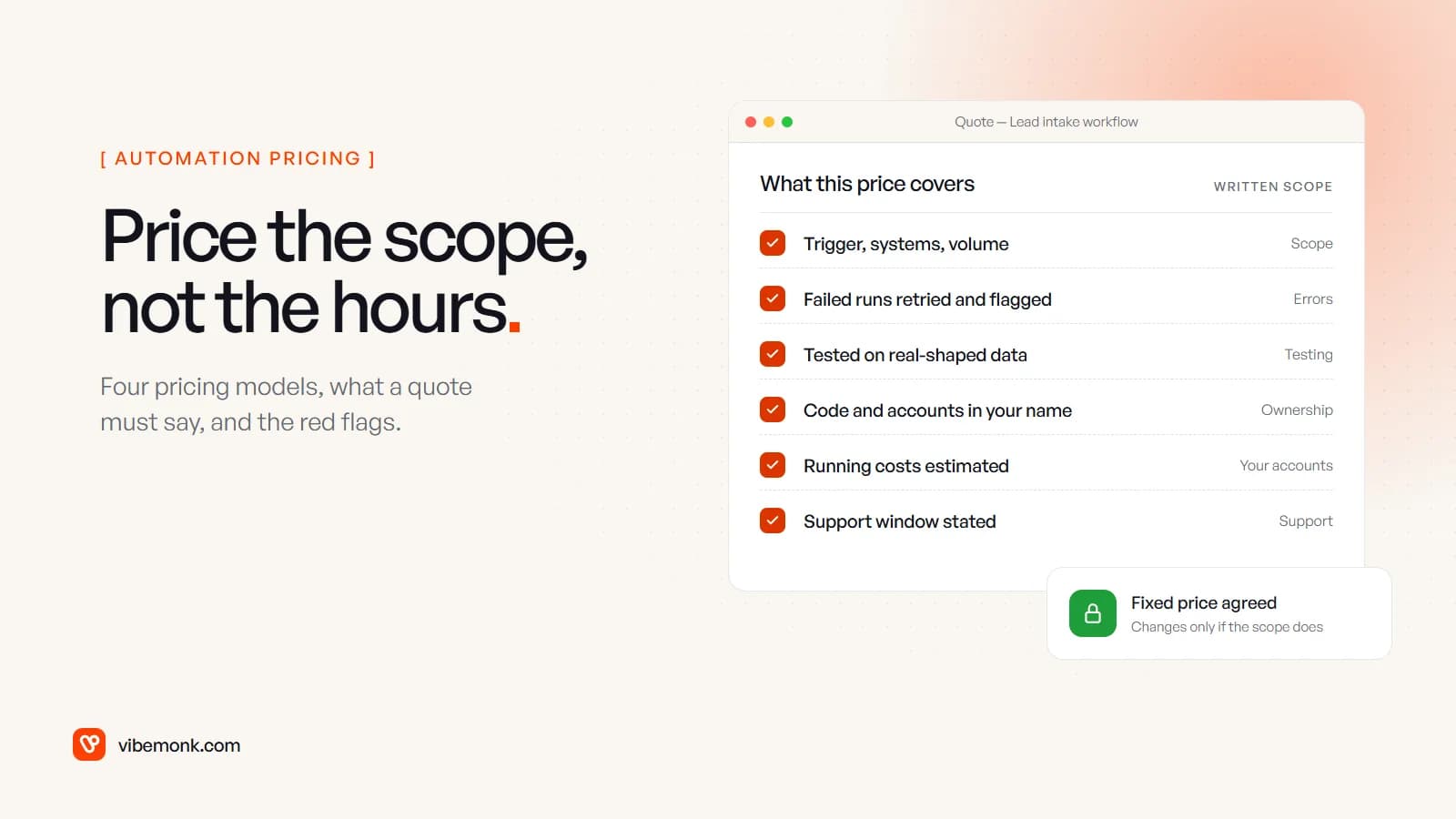
Automation agency pricing comes in four shapes: a fixed price for a written scope, an hourly rate, a monthly retainer, or a price per workflow. The model matters more than the headline number, because it decides who pays when the work takes longer than planned. With a fixed price the agency carries that risk; with hourly billing you do. Whatever the model, the price should buy more than the build: error handling, testing, documentation, handover of the code and accounts, and a stated support window. It should never hide the third-party bills, such as platform tasks and AI model usage, which you pay separately. Below: how each model works, a worked example, what a quote must list, and the red flags.
The four pricing models, and who carries the risk
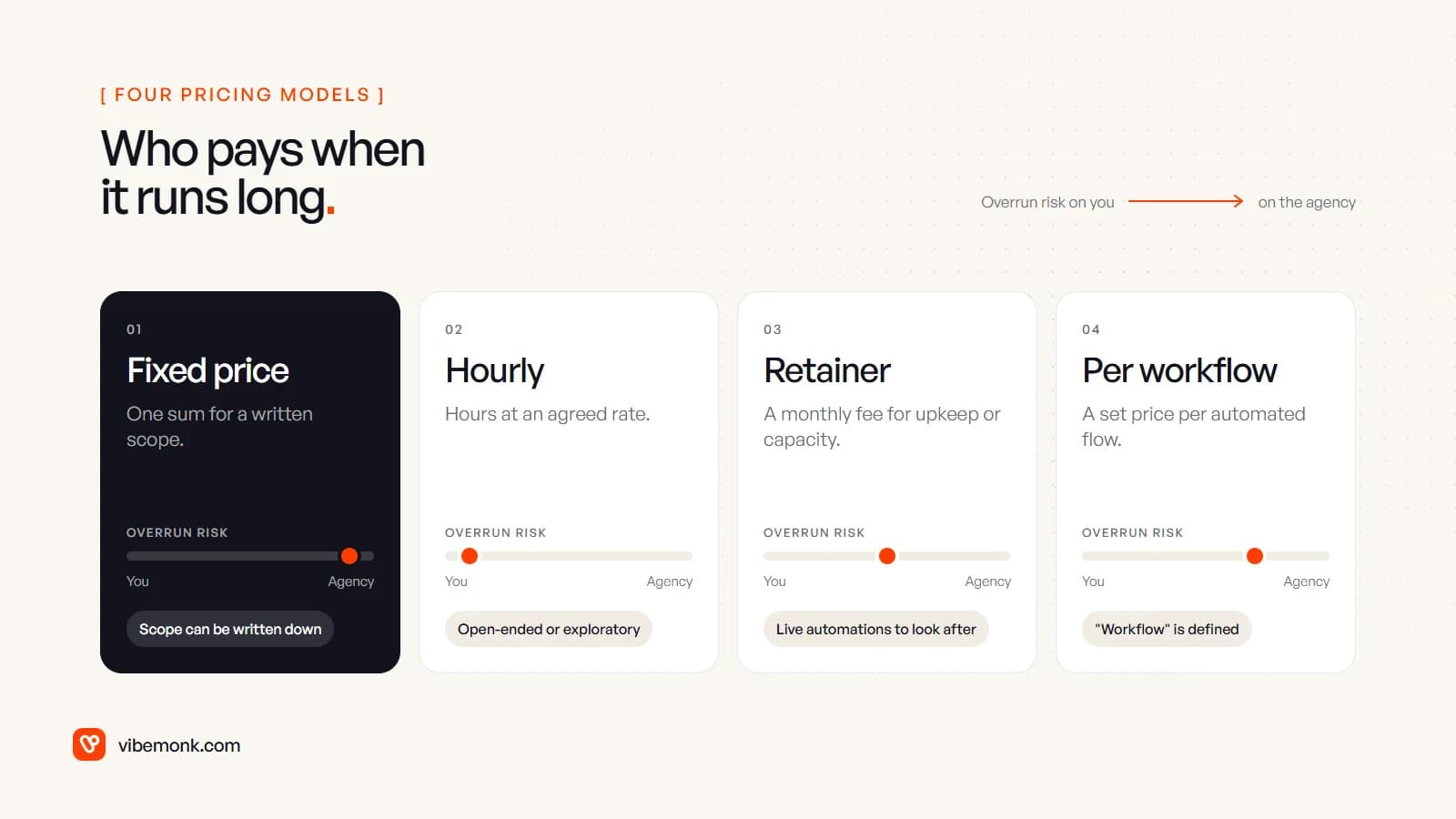
Every agency price is a bet on how long the work will take. The pricing model decides who loses the bet when the estimate is wrong.
| Model | What you buy | Who pays for overruns | Fits when |
|---|---|---|---|
| Fixed price | A written scope, delivered for one agreed sum | The agency | The workflow can be described before work starts |
| Hourly (time and materials) | Hours, at an agreed rate | You | The work is exploratory, or a small open-ended fix |
| Retainer | A monthly fee for an agreed amount of upkeep or capacity | Shared, depending on what the fee covers | Automations are live and need watching and small changes |
| Per workflow | A set price for each automated workflow | The agency, if "workflow" is defined | Repeatable builds of a similar size |
The risk split is not just an opinion. Public procurement rules spell it out. The US Federal Acquisition Regulation says a firm-fixed-price contract "places upon the contractor maximum risk and full responsibility for all costs and resulting profit or loss" (FAR 16.202-1). Of time-and-materials contracts, it says they provide "no positive profit incentive to the contractor for cost control or labor efficiency", which is why the buyer is expected to watch the work closely (FAR 16.601).
You do not need to be a government buyer for that to apply. If you pay by the hour, you are the one who has to check that the hours are well spent.
Two hybrids are common too. Some agencies charge a fixed fee for a short discovery phase and then quote the build, which is sensible when the process is not yet mapped. Others offer performance-based pricing tied to results. That can work when the result is easy to measure and mostly within the agency's control; for most automation work it is neither, so read the definitions closely.
Fixed price vs hourly: one job, two bills
The difference shows up when something takes longer than expected, which in integration work is normal. An API turns out to limit how many requests you can send, a CRM field means something different from what its name says, or the source data is messier than the sample.
Worked example (illustrative figures, not market rates). Say an agency scopes a lead-capture workflow: form submissions are cleaned, de-duplicated, written to the CRM and followed by an email. It estimates 20 hours.
- Hourly at an example $80 an hour: the estimate is 20 × $80 = $1,600. The CRM's API turns out to need batching and retries, which adds 10 hours. The bill becomes 30 × $80 = $2,400. You pay for the surprise.
- Fixed price: the agency quotes, say, $1,900 for the same written scope. The extra $300 over the hourly estimate is its margin for surprises. The same 10 extra hours happen, and the price stays $1,900. The agency pays for the surprise.
If nothing goes wrong, hourly is cheaper in this example. If anything goes wrong, fixed is cheaper, and you knew the number before you started. For a business owner signing off a budget, that certainty is usually worth the margin.
Fixed pricing has its own failure mode: it only protects you for what is in the written scope. An agency can win on a low fixed price with a thin scope, then charge for every change request. So the scope document matters as much as the number, which is the next section but one.
Retainers and per-workflow pricing: read the definitions
Both models are reasonable. Both are easy to write in a way that favours the agency.
Retainers should say what the monthly fee buys. There are two very different products sold under the same word:
- A care or maintenance plan: monitoring, fixing what breaks, dependency and API updates, small changes to existing automations. This is the honest use of a retainer, because live automations do need upkeep: vendors change their APIs, fields get renamed, models get retired.
- A block of hours or capacity: a set amount of time each month for new work. Useful if you have a steady stream of small builds. Wasteful if the hours expire unused, or if new builds are quietly paid for out of hours that were meant for maintenance.
Ask which one you are buying, what happens to unused hours, how quickly they respond when something breaks, and how much notice either side gives to end it.
Per-workflow pricing depends entirely on what counts as one workflow. "Lead capture to CRM" can mean three steps or thirty. A good per-workflow price names the trigger, the systems touched, the steps, the failure cases handled and the volume it is built for. Without that, a per-workflow price is a fixed price with no scope, and the arguments start at the first edge case.
What you are paying for in an automation agency price
A useful way to read any quote is to ask what work sits behind the number. Getting a workflow to run once is the small part. The rest is what keeps it running on day 200:
- Understanding the process: how the work is actually done today, the exceptions, who approves what. This is where wrong builds are prevented, and it is what a discovery phase is for.
- The build: the triggers, the logic, the integrations, any AI steps.
- Failure handling: what happens when an API is down, a record is missing a field, or a model returns something unusable. Retries, alerts, and a place where failed items wait for a person.
- Testing: running the workflow against real-shaped data, including the awkward cases, before it touches live records.
- Deployment and access: running it on accounts you own, with credentials scoped to what it needs.
- Documentation and handover: enough that another developer, or you, can understand and change it later.
- A support window: fixes to the agency's own work for a stated period after launch.
Then there is what is not in the agency's price, and should not be: the third-party bills. Workflow platforms meter usage differently. Zapier counts a task for "any successful action" (Zapier help). n8n counts executions, where "an execution is a single run of your entire workflow" (n8n pricing). AI model providers charge per token: OpenAI's API pricing is listed per million input and output tokens (OpenAI pricing). Hosting, databases and email sending add their own lines.
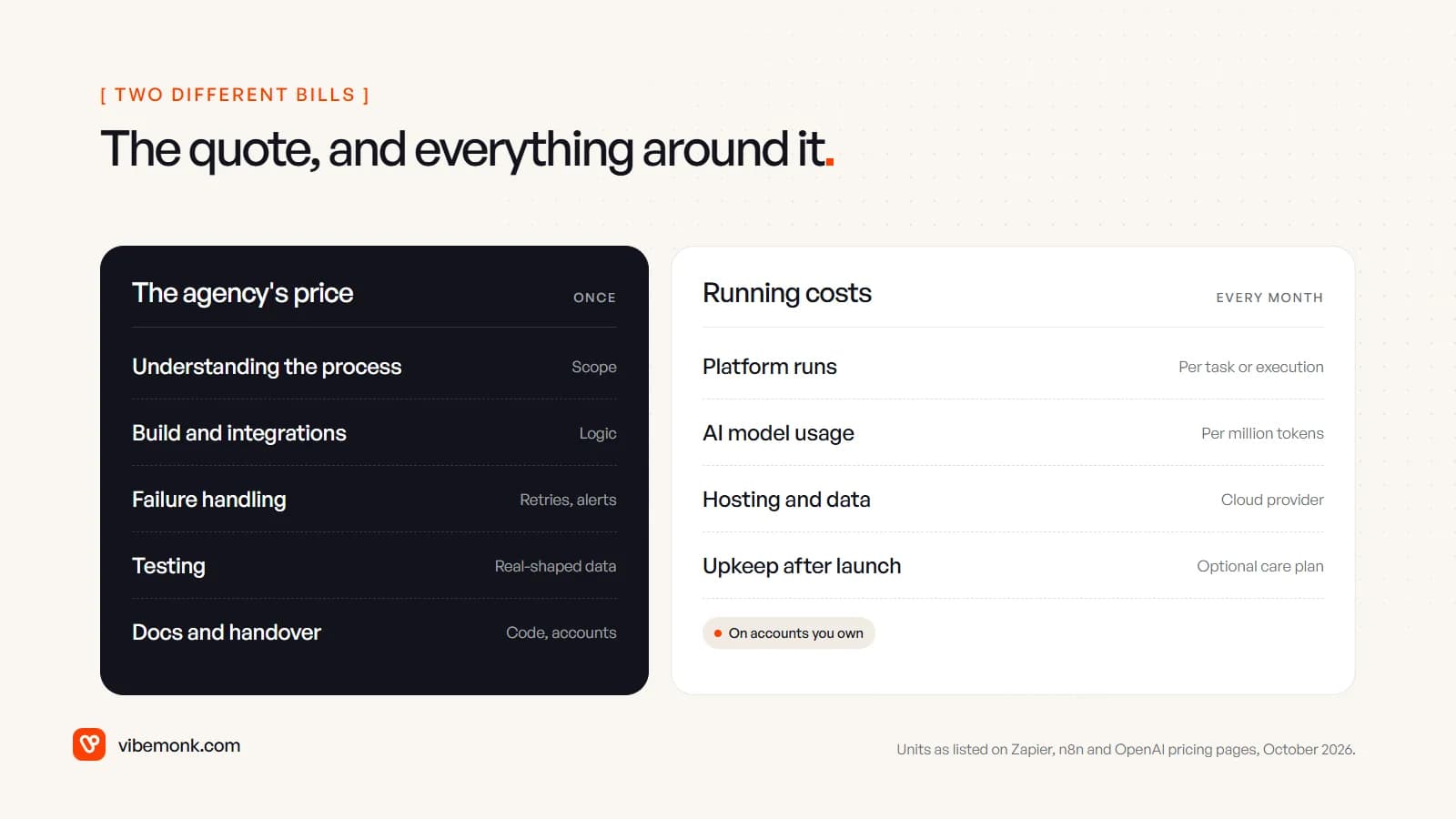
Those running costs should be estimated in the quote and paid on your own accounts, not marked up inside an agency invoice you cannot see into. We go through how to estimate them in AI agent running costs, and through what drives the build price itself in how much AI automation costs for a small business. If you are still choosing a platform, n8n vs Zapier vs custom compares how each one's bill grows.
What a good automation quote includes
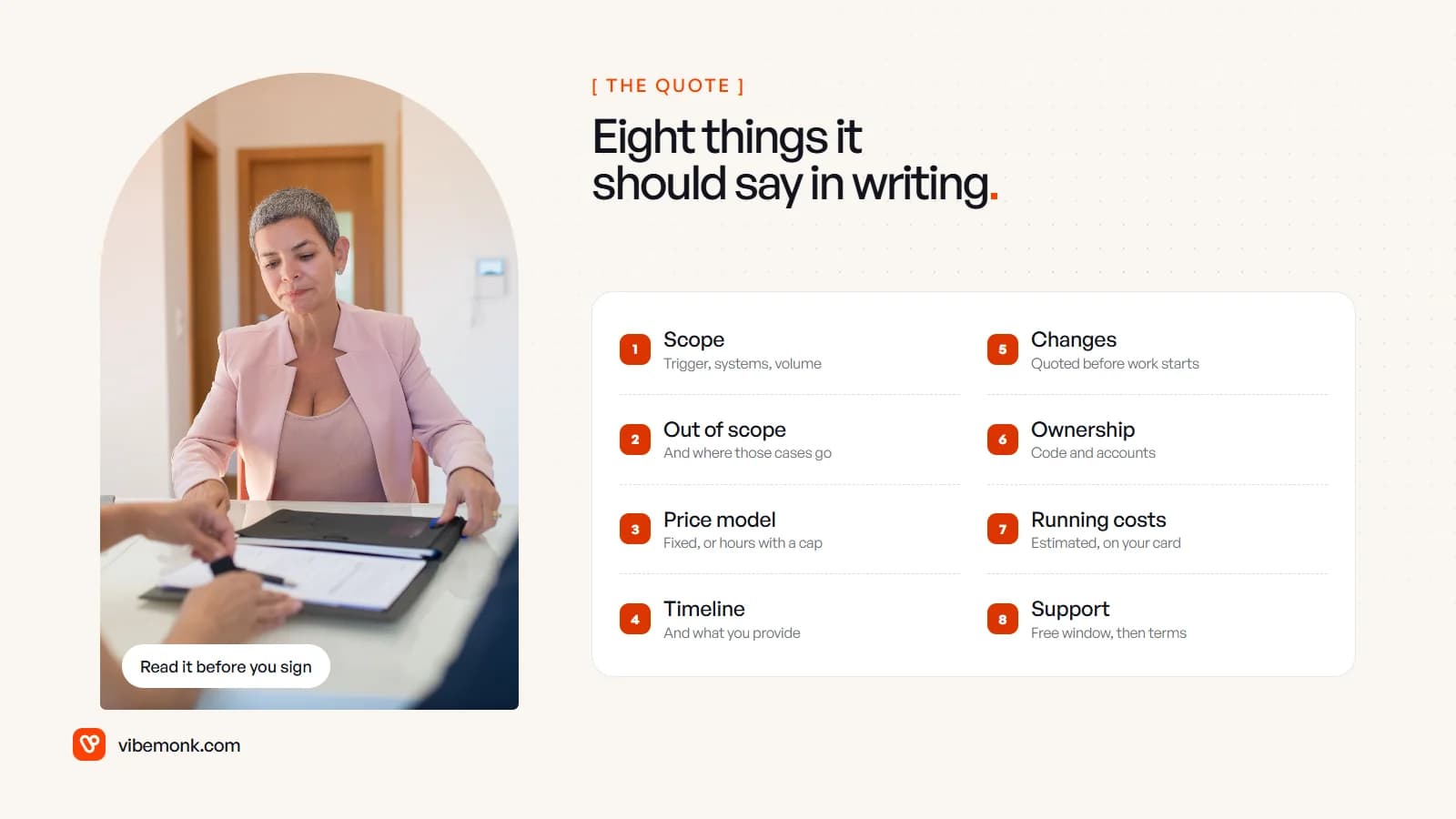
A quote is the document you will point at when there is a disagreement, so it should be specific enough to settle one. Before you sign, check that it lists:
- The scope, in writing: each workflow, its trigger, the systems it reads and writes, and the volume it is built for.
- What is out of scope: the cases the agency is not handling, and what happens to them (usually a queue for a person).
- The price and the pricing model: fixed, hourly with an estimate and a cap, or the retainer terms.
- The timeline and what you must provide: access, sample data, a person who can answer questions about the process.
- How changes are handled: a change is quoted and approved in writing before work on it starts.
- Ownership: who owns the code, the workflows and the accounts on payment.
- Running costs: an estimate of the monthly platform, model and hosting bills, and whose card they are on.
- Support: how long the agency fixes its own bugs for free, and what support costs after that.
The ownership line deserves a moment. Under US copyright law, copyright "vests initially in the author" (17 U.S.C. § 201), and a transfer of ownership is not valid unless it is "in writing and signed" (17 U.S.C. § 204). Commissioned software generally does not fall within the statutory categories of "work made for hire" (17 U.S.C. § 101). In plain terms: paying for the work does not by itself make the code yours. Get the transfer written into the agreement. Rules differ by country, so check with a lawyer where you are, but the safe habit is the same everywhere.
Red flags in automation agency pricing
Most of these are not dishonesty. They are ways of writing a price that leave the risk with you without saying so.
- A price with no written scope. "Automate your lead flow, $X" tells you nothing about what happens on the first record that does not fit.
- Hourly billing with no estimate or cap. Time and materials is fine for exploration. For a defined build, ask for a cap or a fixed price.
- Platform or model costs bundled into the fee. You cannot see what you are paying for usage, and you cannot leave without rebuilding.
- Workflows built in the agency's accounts. If the automations live in their Zapier, n8n or cloud account, you are renting them. Ask for your own accounts from the start.
- No mention of failures. If the quote does not say what happens when a step fails, the answer is probably "nothing, until someone notices".
- No support window, or a retainer required from day one. Bugs in the agency's own work should be fixed for a stated period at no charge. Ongoing care is a separate, optional decision.
- Outcome promises. "Save 40 hours a week" in a quote is marketing. A quote should commit to what will be built, not to results nobody has measured yet.
- No handover. No documentation, no credentials list, no access to the code: you will be paying the same agency for every change, forever.
How Vibemonk prices automation work
We publish starting prices and then quote a fixed price for your scope. The ladder on our pricing page starts at $99 for a Quick Fix, $299 for one automated workflow (typically 3–7 business days), $699 for an AI workflow across several systems (1–2 weeks), $1,499 for a custom internal tool (2–4 weeks) and $2,999 for an MVP or larger system (3–6+ weeks). These are starting points, not averages for the market; the price for your project depends on what it involves.
Every project is scoped first. You get a written scope and a fixed price for that work, and the price changes only if the scope changes, which you approve first. Source code and accounts are handed over with documentation. Third-party costs such as hosting, API usage and software subscriptions are paid by you directly, on accounts you own. After the support window in your quote, an optional Care plan starts at $299 a month for monitoring, fixes, dependency updates and small changes.
If you do not yet know what the workflow should be, that is a scoping problem before it is a pricing one. Our discovery work maps the process and ends with a written plan, a scope and a price; the first call is free.
Before you compare quotes
Comparing two automation quotes by their totals only works if they describe the same work. Usually they do not. Put both against the eight-point list above, ask each agency to fill the gaps, and then compare.
Then choose the pricing model by how well the work can be described. If you can describe the workflow, ask for a fixed price. If you cannot yet, pay for a short discovery and get the fixed price after it. Keep hourly billing for genuinely open-ended work, and treat a retainer as a decision for after launch, once you know what the automations need.
Have a specific workflow in mind? Our AI automation service scopes it, prices it and builds it around how your business actually runs.