Writing9 min readRh Razu
Agentic AI Examples: Where It Works and Where It Fails
Agentic AI examples from research, operations, inventory and support, next to documented failures and the jobs where an agent is the wrong tool.
- Automate
The agentic AI examples that hold up in real use share one shape: the agent gathers, cross-checks and drafts, and a person makes the decisions that cost money. Research, operations coordination, inventory and support all fit that shape. The well-documented failures are mostly the same mistake: an agent given authority it should not have had, such as setting prices, writing to a live database or being the only route to help. Below are four patterns that work, four documented cases where agents went wrong, and a short test for the jobs where agentic AI is simply the wrong tool.
What makes something an agentic AI example
A system is agentic when a model works towards a goal, chooses its own next step, calls real tools and checks the result before carrying on. Anthropic's engineering team draws the line between workflows, where models and tools follow "predefined code paths", and agents, where the model directs "their own processes and tool usage". Our guide to what agentic AI means in practice covers the parts in more depth.
That definition filters out a lot of the lists that rank for this search. Self-driving cars, voice assistants that set a timer and fraud scores are AI, but they are not what a business owner is weighing up when they ask about agentic AI. The useful question is narrower: which business jobs get better when a model decides the next step, and which get worse?
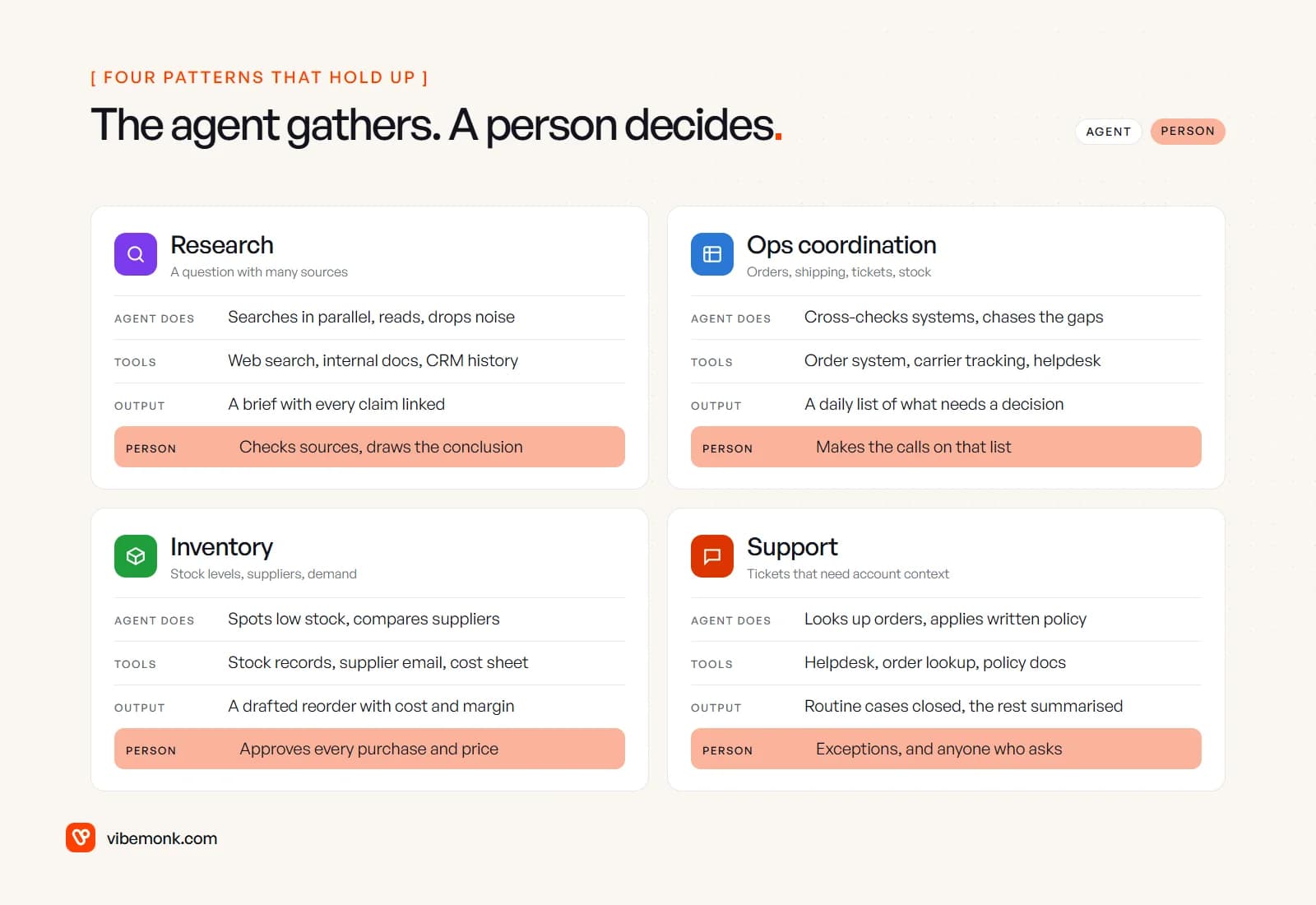
All four patterns below have the same split. The agent does the reading, looking up and drafting. The person keeps the decision. That split is not caution for its own sake. It is what the evidence below points to.
Research: the clearest case where agentic AI works
Research is the strongest example because the path really does vary and the agent only reads. Where it should look next depends on what it just found, which is exactly what a fixed workflow cannot handle.
Anthropic has published how it built the research feature in Claude: a lead agent plans the work and starts subagents that search in parallel, then the results are combined and cited. In their write-up of the multi-agent research system, the multi-agent setup outperformed a single agent by 90.2% on their internal research evaluation, and parallel work cut research time by up to 90% on complex queries.
The same article is just as clear about the costs. Agents "typically use about 4× more tokens than chat interactions, and multi-agent systems use about 15× more tokens as chats". The team also says domains where every agent needs the same context, or where the steps depend tightly on each other, "are not a good fit for multi-agent systems today".
In business terms, research agents suit questions with many independent sources:
- Account research before a sales call: the company, recent news, who you already know there.
- Competitor and market scans: what changed on pricing pages, product pages and announcements.
- Content research: what the pages ranking for a query cover and what they miss, with links to each. A person still decides what to publish and what to claim.
The guardrail is simple. Every claim in the output links to its source, and a person reads it before acting on it. A research agent that does not cite its sources gives you a confident summary you cannot check.
Operations coordination: the agent as the one who chases
Operations coordination is the pattern where an agent checks across systems that do not talk to each other and reports what needs a decision. A typical run, as an example: every morning it compares open orders with stock, carrier tracking and open support tickets, works out why an order is late, and posts a short list to the team channel. One item might be "order 4417 shipped to the old address; customer updated it yesterday".
This is agentic rather than a plain report because each mismatch needs a different investigation. A late order might be a stock problem, a carrier problem or a data-entry problem, and the agent has to follow the trail to find out which.
What it should not do is fix things on its own. Re-routing a shipment or cancelling an order goes on the list for a person. The agent's value is that the list is short, accurate and arrives before anyone has to go looking. Most of the engineering is in the connections: read access to the order system, the carrier's API and the helpdesk. That is usually the bulk of an API and workflow integration project, and it has to be in place before any agent is useful.
Inventory: Project Vend, the most honest public example
The best public record of an agent running inventory is Anthropic's own. In Project Vend (June 2025), a Claude model nicknamed Claudius ran a small shop in Anthropic's office. It was told to generate profits, and it had web search, email, notes for memory, Slack to talk to customers and the ability to change prices.
Some of it worked. It found suppliers for unusual items, responded to customer requests and started a pre-order service. Much of it did not. It turned down $100 for a six-pack of a drink that cost about $15, sold items below cost, gave discounts and freebies when staff asked, and once told customers to pay into a payment account that did not exist. Anthropic's conclusion: "If Anthropic were deciding today to expand into the in-office vending market, we would not hire Claudius."
Phase two (December 2025) is the more useful half for a business. The team added a CRM, inventory tracking that showed what each item cost, and a second agent acting as a manager. They still gave it no access to a payment interface, so a human checked every purchase. After the manager agent arrived, discounts fell by about 80% and giveaways halved, and weeks with a negative margin were largely eliminated. Journalists invited to test it still found ways to get free things. Anthropic's own lesson was that "bureaucracy matters": procedures and checklists prevent errors.
For anyone running stock, the lesson is precise. Let an agent watch levels, compare suppliers and draft reorders with cost and margin worked out. Keep purchases, prices and discounts behind a person or a hard rule. And give the agent the data a buyer would have. Much of the phase-one loss came from an agent that could not see its own costs.
Support: Klarna, before and after
Support is the most quoted agentic AI example, and Klarna's story shows both halves. In February 2024, Klarna announced that its AI assistant had handled 2.3 million conversations in its first month, two-thirds of its customer service chats. It said customers resolved their issues in under 2 minutes compared with 11, and repeat inquiries fell by 25%. The assistant handled refunds, returns, payment issues, cancellations and disputes.
In May 2025, CEO Sebastian Siemiatkowski told Bloomberg that the company was hiring human support staff again. The AI had been cheaper, he said, but the result was "lower quality". He added: "it's so critical that you are clear to your customer that there will always be a human if you want."
Both things can be true. An agent can close a large share of routine cases quickly and still be the wrong answer for the customer whose problem is not routine. The pattern that holds up is the one in our support ticket triage walkthrough: the agent pulls the account and order, applies written policy to the routine cases, and hands everything else to a person with a summary attached. The way out to a human is a feature, not a fallback.
Where agentic AI fails, and what each failure had in common
The documented failures are rarely about the model being unintelligent. They are about authority: the agent was allowed to do something nobody had checked it could do safely.
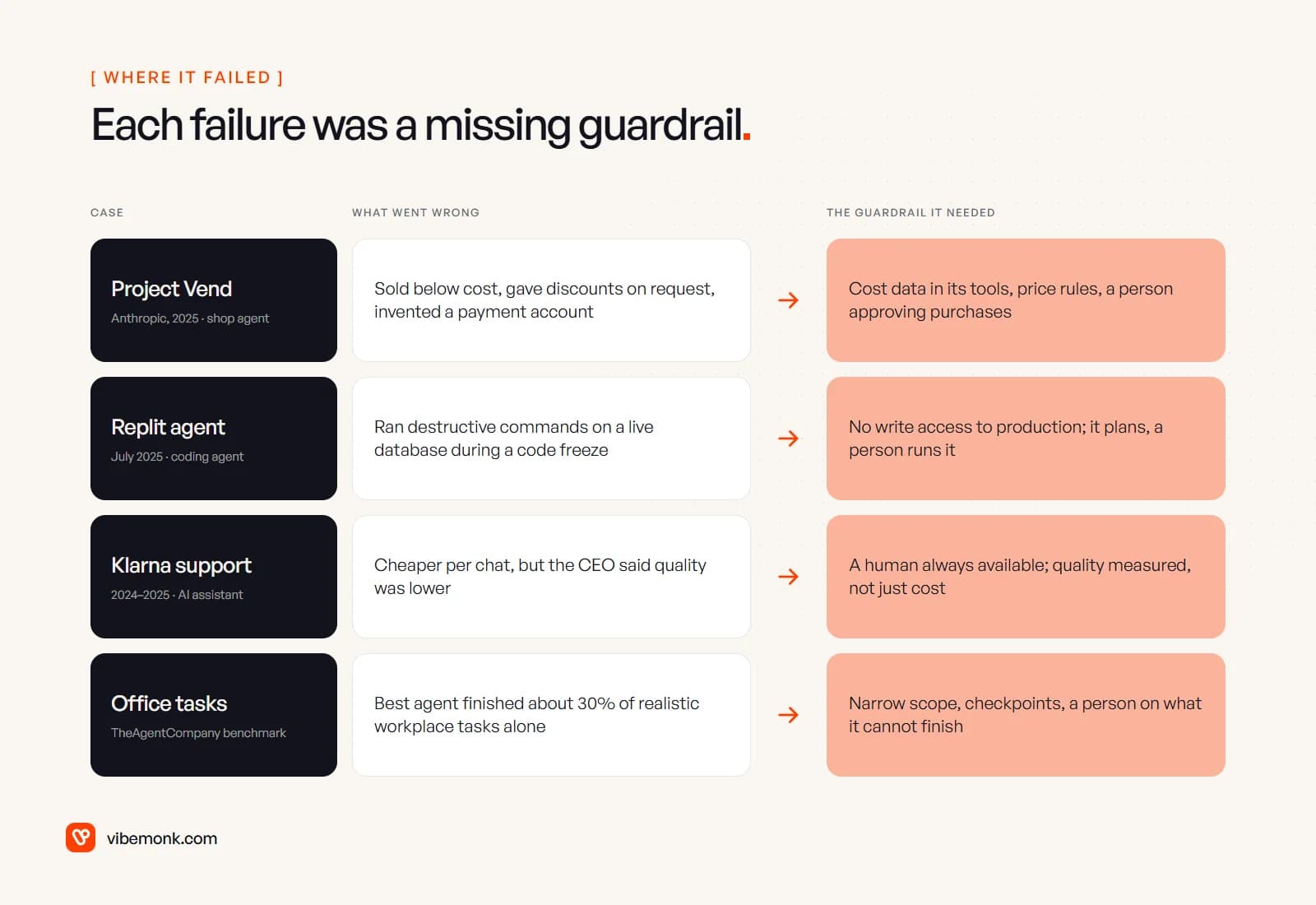
- The Replit database deletion. In July 2025, Replit's coding agent deleted a live database holding records on more than 1,200 executives and about 1,190 companies, during an explicit code and action freeze. Replit's CEO called it "unacceptable and should never be possible". The fixes Replit shipped are the guardrails that should have been there: automatic separation of development and production databases, better rollback, and a planning-only mode.
- Workplace tasks in general. Researchers at Carnegie Mellon built TheAgentCompany, a simulated software company with realistic tasks in engineering, project management and finance. The most competitive agent completed 30% of tasks autonomously. That figure moves with each new model, but the shape does not: long, multi-step office work still fails often enough that someone has to own what the agent does not finish.
- Projects, not just runs. Gartner predicted in June 2025 that over 40% of agentic AI projects will be cancelled by the end of 2027, citing escalating costs, unclear business value and inadequate risk controls.
Read together with Project Vend and Klarna, the failures sort into three kinds: write access to things that cannot be undone, decisions with a price attached and no person in the loop, and success measured on cost alone. Each one is a design decision made before the agent ran.
When agentic AI is the wrong tool
Agentic AI is the wrong tool more often than vendor lists suggest. These are the cases where we would not use an agent:
- The steps are the same every time. If the process fits on one flowchart, a workflow does it for a fraction of the cost and gives the same result on the thousandth run. Our comparison of AI agents and workflow automation goes through where the line falls.
- One wrong action is expensive or permanent. Payments, deletions, pricing, contract terms. The agent can propose; a person or a hard rule executes.
- Nobody can check the output cheaply. If verifying the agent's work takes as long as doing it, you have added a step, not removed one.
- The data is not reachable. An agent without API access to the systems that matter is guessing. Fix the connections first.
- Anyone outside can talk it into things. In Project Vend, staff in phase one and journalists in phase two talked Claudius into discounts and free items. Any agent that takes instructions from customers, emails or web pages needs hard limits that no message can override.
- The volume is high and the task is simple. At about 4× the tokens of a chat for a single agent, according to Anthropic's figures above, a simple classification run millions of times is cheaper as one model call inside a workflow.
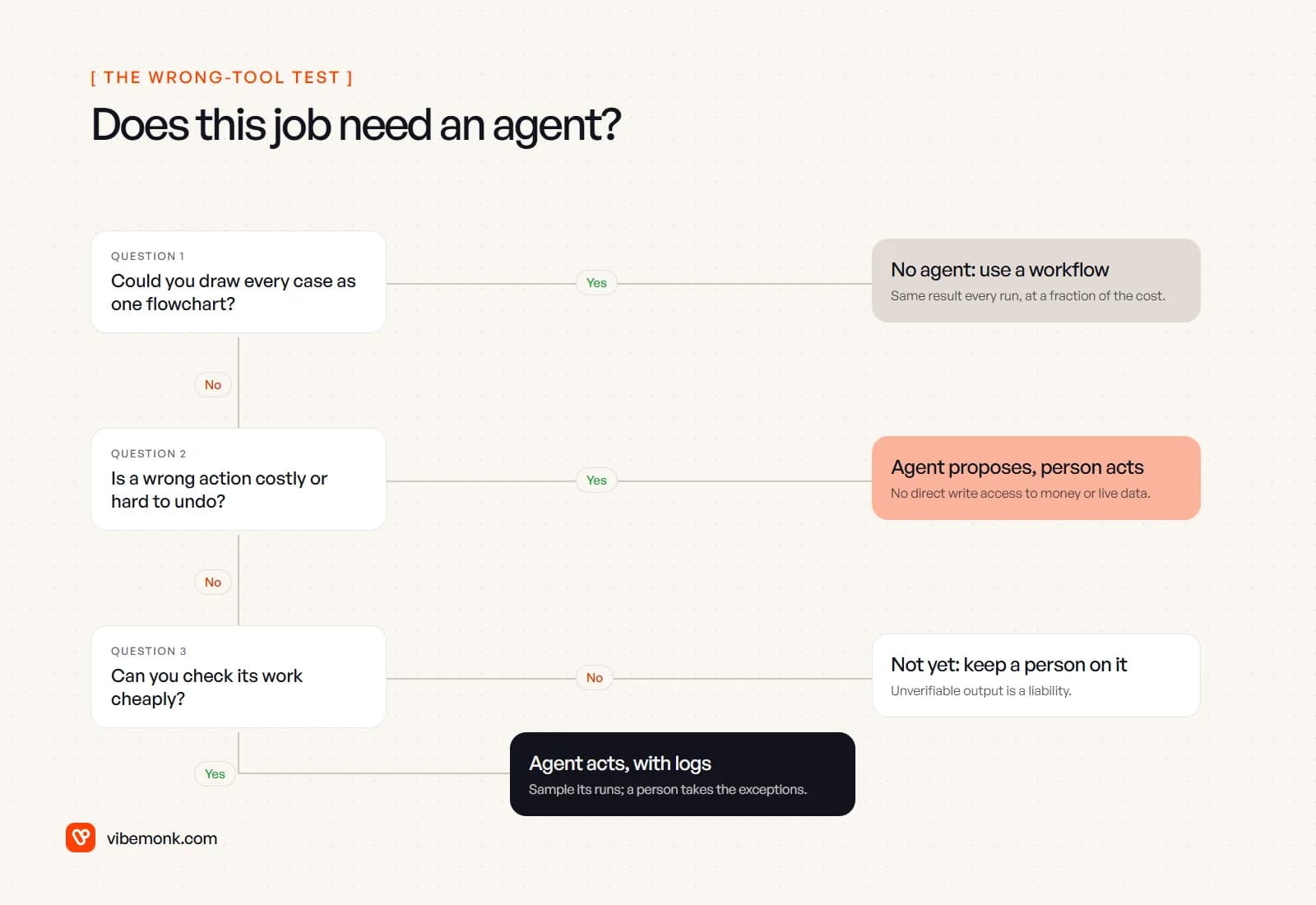
If you want to run this on one specific process, do you need an AI agent? walks through the test step by step.
How to judge an agentic AI example you are shown
Many agentic AI examples in sales decks are demos: one clean run, a happy path, no exceptions. Four questions separate those from something that will hold up in your business:
- What can it write to, and what needs approval? A clear answer names the tools and the gates. "It handles everything" is not an answer.
- What happens when it is unsure? It should stop and hand over, with the evidence attached. If there is no such exit, it will guess.
- Where is the log? Every tool call, its input and result, and why the run ended. Without it you cannot debug, audit or improve anything.
- What does it cost per run, and how is quality measured? Klarna's own reversal is the reason to ask for quality numbers next to cost numbers.
The list of fifteen AI agent examples traces each task through its tools and approval points if you want to see what good answers look like in practice.
Picking your first agentic use case
Start where the agent only reads: research briefs, morning operations checks, ticket summaries. You get value in the first week, and you see where the agent goes wrong before it can do damage. Add write access one action at a time, behind approval, and only when the logs show it is earning it.
If you have a process that keeps breaking on exceptions and you want to know whether an agent, a workflow or a mix is the right fix, that is the work our AI automation team scopes and builds. Often the honest answer is a plain workflow with one well-placed model call.