Writing10 min readRh Razu
Agentic AI vs Generative AI: What Changes in Practice
Agentic AI vs generative AI for teams using AI daily: what changes when AI stops drafting and starts acting, from review and permissions to cost and risk.
- Grow
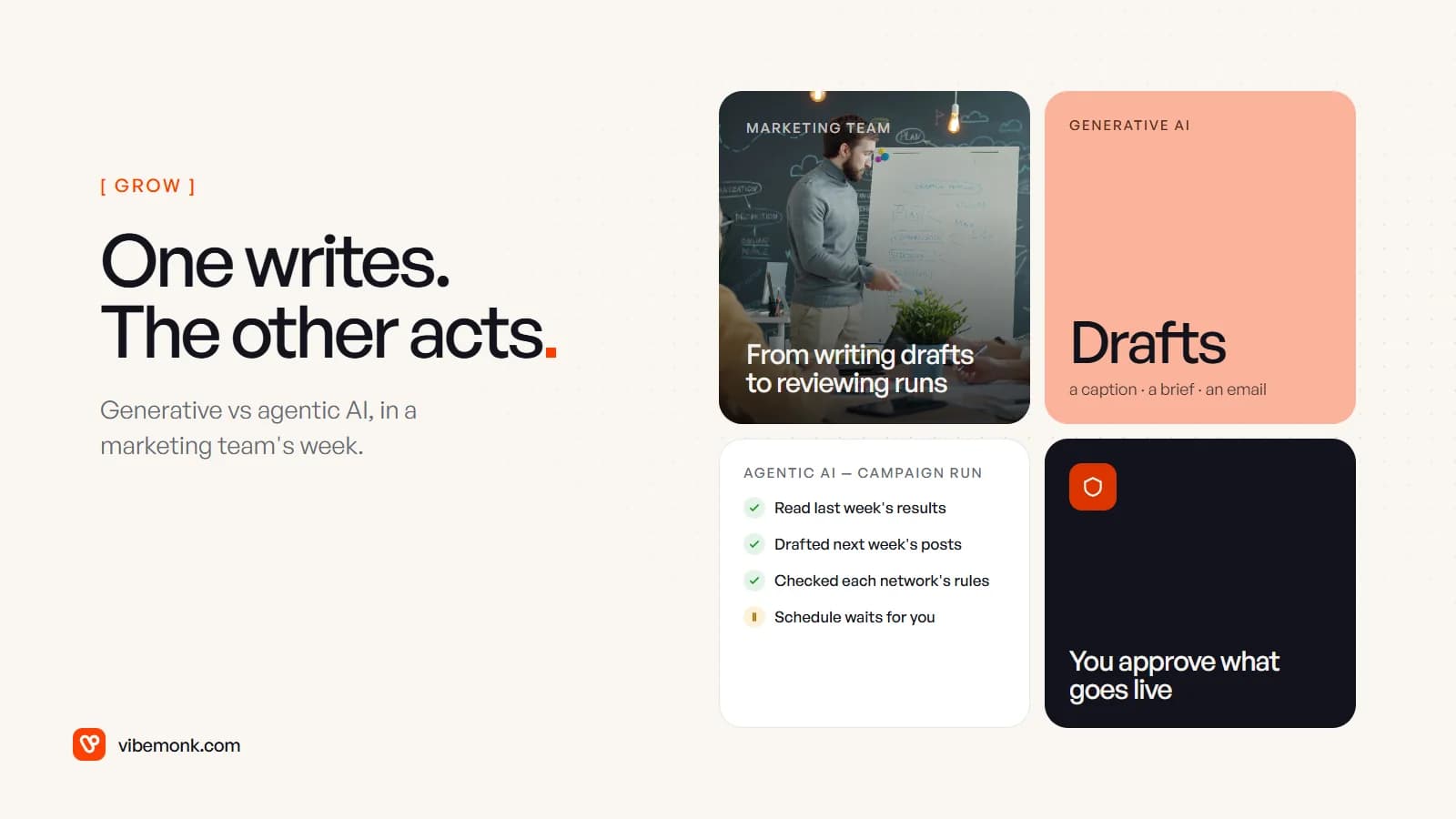
The difference between agentic AI vs generative AI is the difference between a draft and a done job. Generative AI produces content: you ask, it writes a caption, an email, an image, and a person decides what happens next. Agentic AI acts: you give it a goal, it reads your data, calls your tools, takes several steps on its own and stops where you told it to. The same model can sit underneath both.
For a team that uses AI every day, that shift changes more than the tool. It changes what you review, what you have to give the AI access to, what a mistake costs, and how you measure whether it is working. This post walks through those changes on one concrete case: content work versus campaign operations in a marketing team.
Agentic AI vs generative AI, side by side
If you want the definitions and the theory, our guide to what agentic AI is covers them. The short version, from the point of view of the person using it:
| Generative AI | Agentic AI | |
|---|---|---|
| You give it | A prompt | A goal, the tools it may use, and limits |
| It gives back | Content: text, images, code | A finished task, or a stop with a question |
| Who decides the next step | You, every time | The model, inside the limits you set |
| What it can touch | Nothing outside the answer | The systems it is connected to |
| If nobody reads the output | Nothing happens | Something in your business changes |
| A typical mistake | A weak or wrong draft | A wrong action: a post, an email, a spend |
| Cost per task | One or a few model calls | Many calls, varying run to run |
| What you review | The output | The run: what it did and why it stopped |
The row that matters most is the fifth. With generative AI, a person stands between the model and the world by default. With agentic AI, that person has to be designed in, at specific points, or they are not there at all.
Anthropic's engineering team, in its widely cited post on building effective agents, describes agents as systems where models "dynamically direct their own processes and tool usage". That control over the process is what you are buying, and it is also what you now have to manage.
The same job done both ways
Take a job most marketing teams do weekly: plan and publish next week's social posts across several networks, informed by what worked last week.
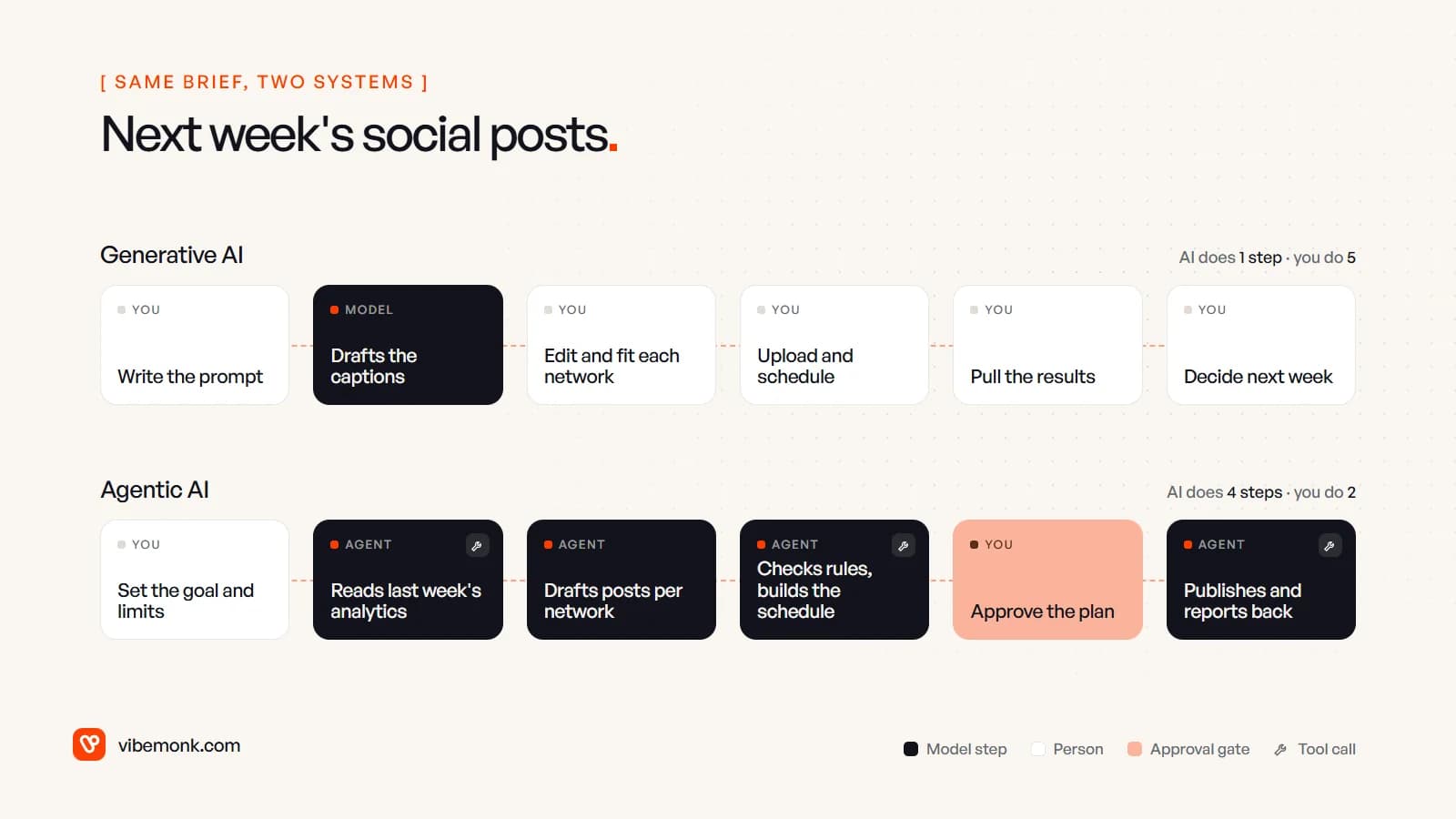
With generative AI, the model does one step well. You write a prompt, it drafts captions, and then the work goes back to you: trim each caption to each network's limits, upload the media, schedule the posts, pull the numbers at the end of the week, decide what to change. The AI saved you the blank page. It did not save you the operations.
With agentic AI, you set the goal and the limits once: the networks, the posting windows, the brand guide, the topics to avoid, a rule that nothing publishes without approval. The agent reads last week's analytics, drafts posts per network, checks each against the network's rules, builds a schedule, and puts the whole plan in front of you. You approve or send it back with notes. It then publishes and reports what happened.
Notice what did not change: a person still decides what goes out under the brand's name. What changed is where that person's time goes. Less writing and copying between tabs, more reviewing a complete plan and the reasoning behind it.
What changes for the team day to day
Moving from generative to agentic AI changes six things about daily work. Most teams expect the first and are surprised by the rest.
1. Prompts become briefs
A prompt asks for one output. An agent needs a brief it can work from for weeks: the goal, the sources it should read, the tools it may use, the things it must never do, and when to stop and ask. Writing that brief well is closer to writing a process document than a prompt. A vague brief does not give you a vague draft; it gives you a confident run in the wrong direction.
2. Review moves from the output to the run
With generative AI you read the draft. With an agent you also need to see what it looked at, which tools it called, what it decided and why it stopped. A good agentic system shows a log for each run. Reviewing a run is a different skill from editing copy, and someone on the team has to own it.
3. Access becomes a decision
Generative AI only needs what you paste into it. An agent needs accounts: the analytics tool, the scheduler, the CRM, perhaps the ad platform. Each connection is a decision about what it may read and what it may change. More on this in the next section, because it is where most of the risk lives.
4. Mistakes get more expensive
A bad draft costs a few minutes of editing. A wrong action costs more: a post published on the wrong account, an email sent to the wrong segment, a budget raised on the wrong campaign. Errors can also compound. Anthropic's post notes that "the autonomous nature of agents means higher costs, and the potential for compounding errors", and recommends "extensive testing in sandboxed environments, along with the appropriate guardrails".
Campaign work adds a specific risk: agents read content written by strangers. Comments, DMs, form fills and web pages can contain text that tries to give the model instructions. OWASP's guidance on prompt injection names this directly: indirect injections "occur when an LLM accepts input from external sources, such as websites or files". An agent that triages comments needs to treat them as data, never as orders.
5. Cost becomes variable
A generative request is one or a few model calls, so its cost is easy to predict. An agent loops: read, decide, call a tool, read the result, decide again. The number of calls varies from run to run. Anthropic's advice is blunt: agentic systems "often trade latency and cost for better task performance, and you should consider when this tradeoff makes sense." Budget per run, not per seat, and watch the long tail of runs that went round the loop too many times.
6. Measurement shifts from quality to outcomes
You judge a draft by reading it. You judge an agent by numbers over many runs: how often it finished without help, how often a person had to correct it, how long the approval step took, what each run cost, and whether the result beat the old way. If you do not record the old way first, you will not be able to tell.
Permissions: what generative AI never asked you to decide
The most practical difference between the two is permissions. A generative tool cannot do damage outside its answer. An agent can do anything its connected accounts allow, so the account settings are the real guardrail, not the prompt.
OWASP lists this as its own risk, excessive agency, with three root causes: excessive functionality, excessive permissions and excessive autonomy. Its mitigations read like a checklist for a campaign agent: limit the tools it can call "to only the minimum necessary", "require a human to approve high-impact actions", and enforce authorisation in the downstream systems rather than trusting the model to decide what it may do.
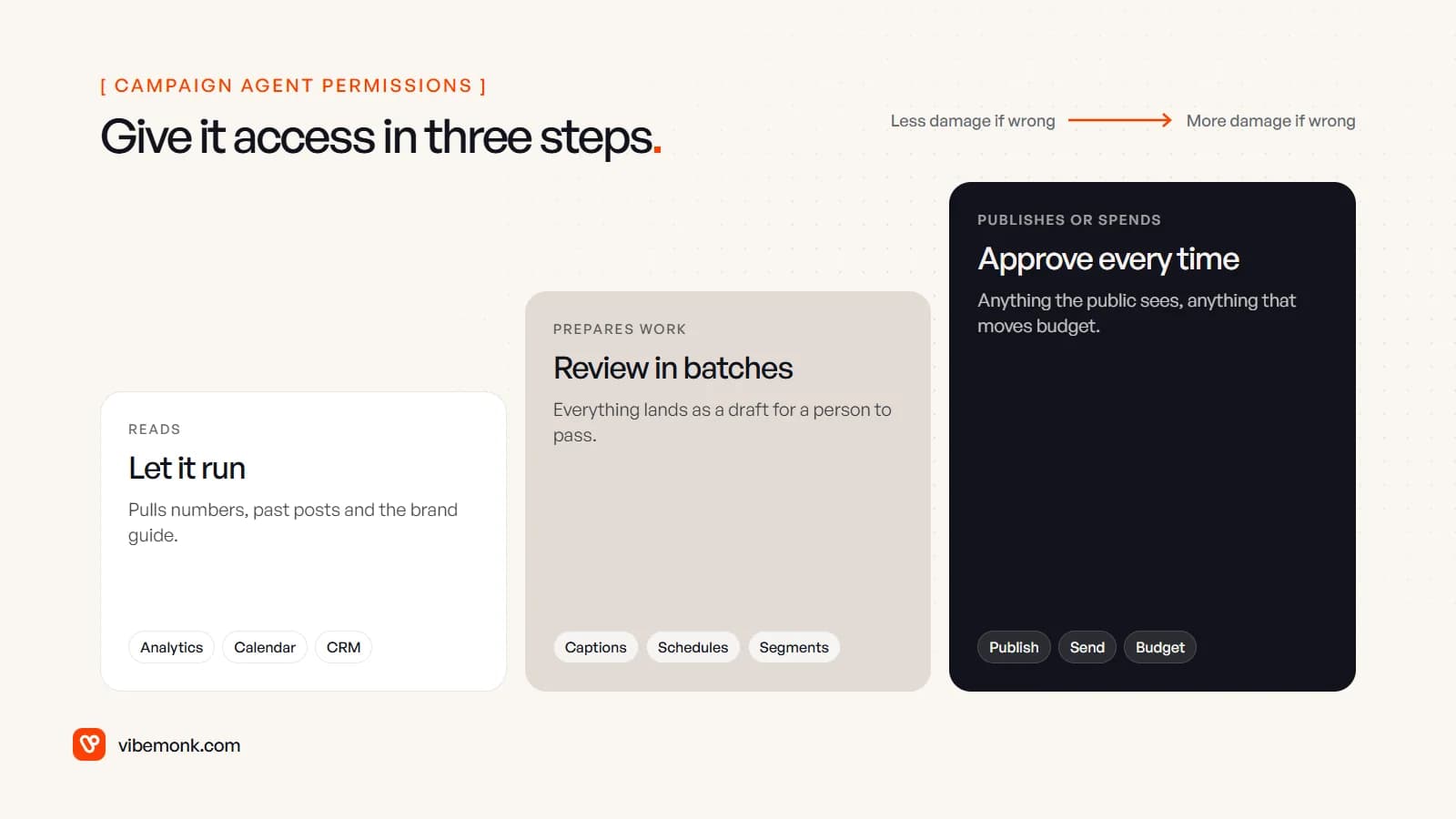
For marketing work, that turns into three levels:
- Reads: let it run. Analytics, the content calendar, past posts, the brand guide, CRM fields. Read-only access is where an agent earns trust cheaply.
- Prepares work: review in batches. Captions, a draft schedule, an audience segment. Everything lands as a draft in the tool you already use, and a person passes it.
- Publishes or spends: approve every time. Anything the public sees and anything that moves budget. Relax this only for narrow, logged cases after weeks of clean runs, and never by default.
Use separate accounts or API keys for the agent where the platform allows it, with the smallest scopes that cover the job. That way the logs show what the agent did, and you can switch it off without locking out the team.
Which marketing jobs need which
Not every job improves when you make it agentic. The useful split has three columns, not two, because a lot of marketing operations work is neither generative nor agentic. It is plain automation.
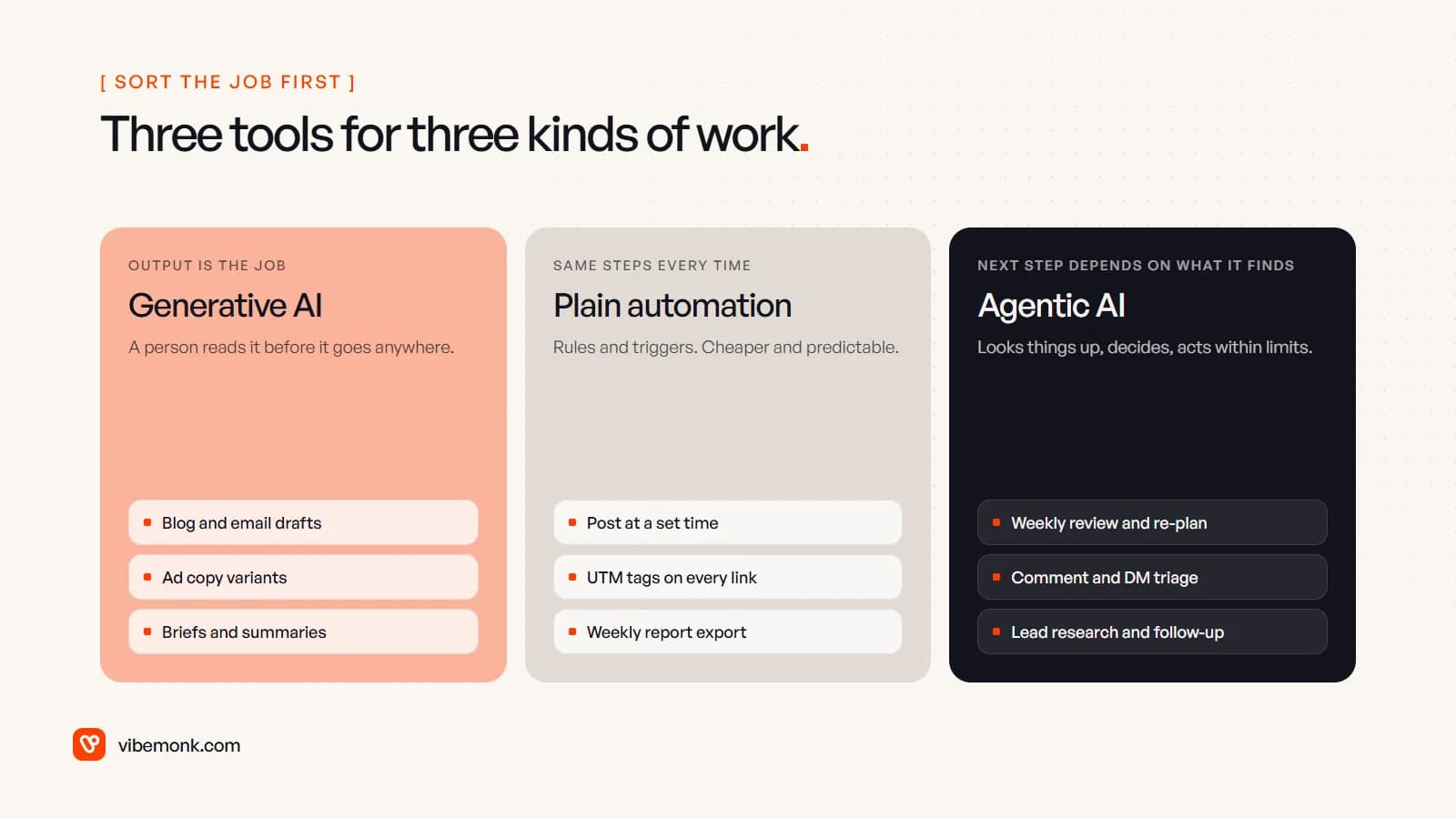
- Generative AI fits when the output is the job and a person reads it before it goes anywhere: blog and email drafts, ad copy variants, creative briefs, summaries of a call or a report.
- Plain automation fits when the steps are the same every time: publish at 9am, add UTM parameters to every link, export the weekly numbers to a sheet. Rules are cheaper than a model and behave the same on the thousandth run. Our guide to AI workflow automation covers where a single model step inside a fixed workflow is enough.
- Agentic AI fits when the next step depends on what the last one found: reviewing last week's results and re-planning the calendar, triaging comments and DMs into reply, escalate or ignore, researching a new lead and drafting a tailored follow-up.
A quick test: write the job down as a flowchart. If the flowchart covers nearly every case, build the flowchart. If every box says "it depends", that is where an agent can help. The same question separates agents from assistants, as our AI agent vs chatbot comparison shows.
From an SEO and content point of view, the split matters for one more reason. Content quality is still a human call. An agent can research, outline, check internal links and publish on schedule, but the judgement about whether a piece says something useful should stay with the person whose name is on it.
What both look like inside one product
A real system usually has both, side by side. Our uContents case study is a social media publishing platform, and it shows the split clearly.
The generative part writes. According to the case study, uContents samples eight frames across a video and tiles them into one image, so the model sees the whole clip before it drafts the caption, title and hashtags. That is generative AI doing what it is good at: producing content from an input, for a person to use.
The agentic part acts, and it is fenced in. The AI studio agent has tools and a memory per brand, and asks for approval before anything that costs credits or changes data. The platform also runs an MCP server, so outside agents such as Claude can work with posts, campaigns, media and analytics; anything that writes is proposed first and has to be confirmed by a person within fifteen minutes. Before any of that, each network's rules are checked up front, so a post that cannot publish never reaches the queue.
That is the pattern in practice: let the model draft freely, let the agent prepare and propose, and keep the final write behind a confirmation. If the tool connection side interests you, our explainer on MCP covers how agents reach business tools.
Where a team should start
Adoption is wide but still shallow. McKinsey's State of AI 2025 survey found 23% of respondents' organisations scaling an agentic AI system somewhere, with a further 39% experimenting with agents. In other words, most organisations are still working out where agents fit. There is no prize for going big first; there is a lot to learn from one small, well-logged job.
A sensible order for a marketing or content team:
- Keep generative AI where it already works. Drafting is a solved problem for most teams. Making it agentic adds cost and risk without much gain.
- List the operations work around the content. Formatting per network, scheduling, pulling numbers, chasing approvals, triaging comments. That is where the hours go.
- Automate the fixed parts with rules first. Anything that follows the same steps every time does not need a model.
- Pick one judgement-heavy job for an agent. The weekly review-and-re-plan is a good first candidate: it reads a lot, decides a little, and its output is a plan a person approves anyway.
- Start read-only, with an approval gate on every write. Log every run. Relax gates one at a time, only when the logs show the agent gets that step right.
- Measure against the old way on time per week, corrections needed and cost per run. Keep the agent only if it clearly wins.
The decision that matters is not generative or agentic. It is which steps of your process need judgement, which need rules, and where a person has to say yes. If you have a campaign or content workflow that is mostly copying between tools, that is the kind of system we design in our AI automation work, and the honest answer is often a fixed workflow with one well-placed agent step rather than an agent running everything.