Writing10 min readShimanto
How Much Does It Cost to Build an AI Agent in 2026?
AI agent development cost depends on scope, not a market average: the 14 cost drivers, five tiers from simple to production, and how to estimate yours.
- Build
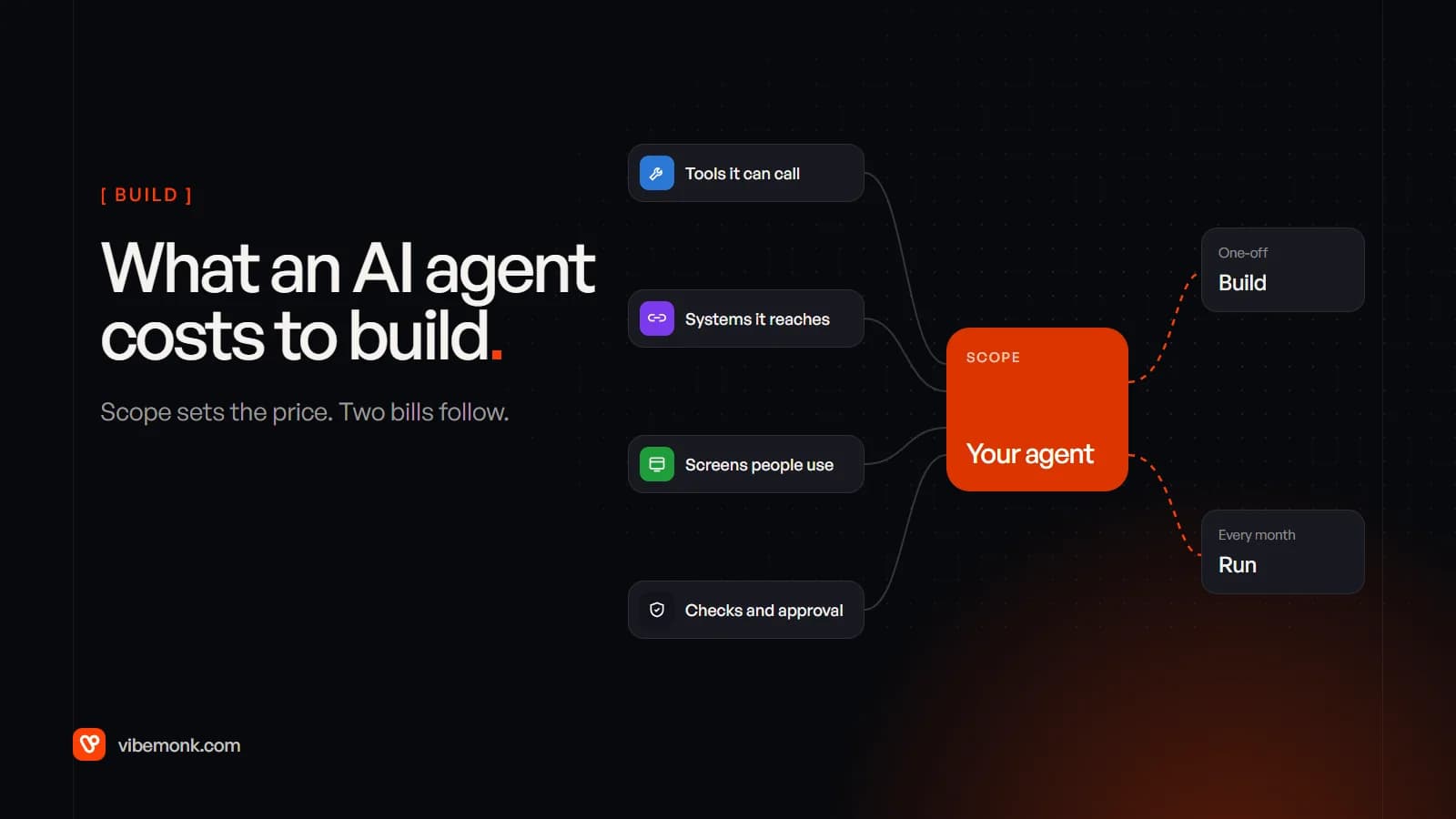
There is no honest single figure for AI agent development cost, because the agent is the cheap part. A model that reads an email and drafts a reply is a small build. What makes the bill bigger is everything around it: how many tools the agent can call, how many of your systems it writes to, whether people need a screen to approve its work, and how carefully it has to be tested and watched once it is live.
So the useful answer has two halves. Build cost is one-off and set by scope. Run cost is monthly and set by volume, model choice and upkeep. This post covers the 14 things that move both, five tiers from a simple agent to a production system, what model usage costs in a worked example, and where our own starting prices sit.
Why there is no honest average price
Search for this question and you will find confident ranges, often from tens of thousands of dollars into six figures. Read where they come from. In the top-ranking guides we read, the bands were each agency's own, with no survey or dataset behind them. That does not make them wrong for that agency, but it makes them useless as a benchmark: they mix a proof of concept with an enterprise platform and a freelancer's day rate with a consultancy's.
The more reliable way to think about price is the one the model makers themselves suggest. Anthropic's engineering guide, Building effective agents, recommends "finding the simplest solution possible, and only increasing complexity when needed", and warns that "the autonomous nature of agents means higher costs, and the potential for compounding errors." Cost follows autonomy. The more an agent is allowed to decide and do, the more has to be built around it to keep it right.
If you are not yet sure the job needs an agent at all, settle that first: do you need an AI agent runs one workflow through a five-question test. Often the cheaper answer is a fixed workflow with one AI step in it.
What drives AI agent development cost
Fourteen things decide the quote. They fall into four groups, and each lands on one of two bills: the build (paid once) or the run (paid every month).
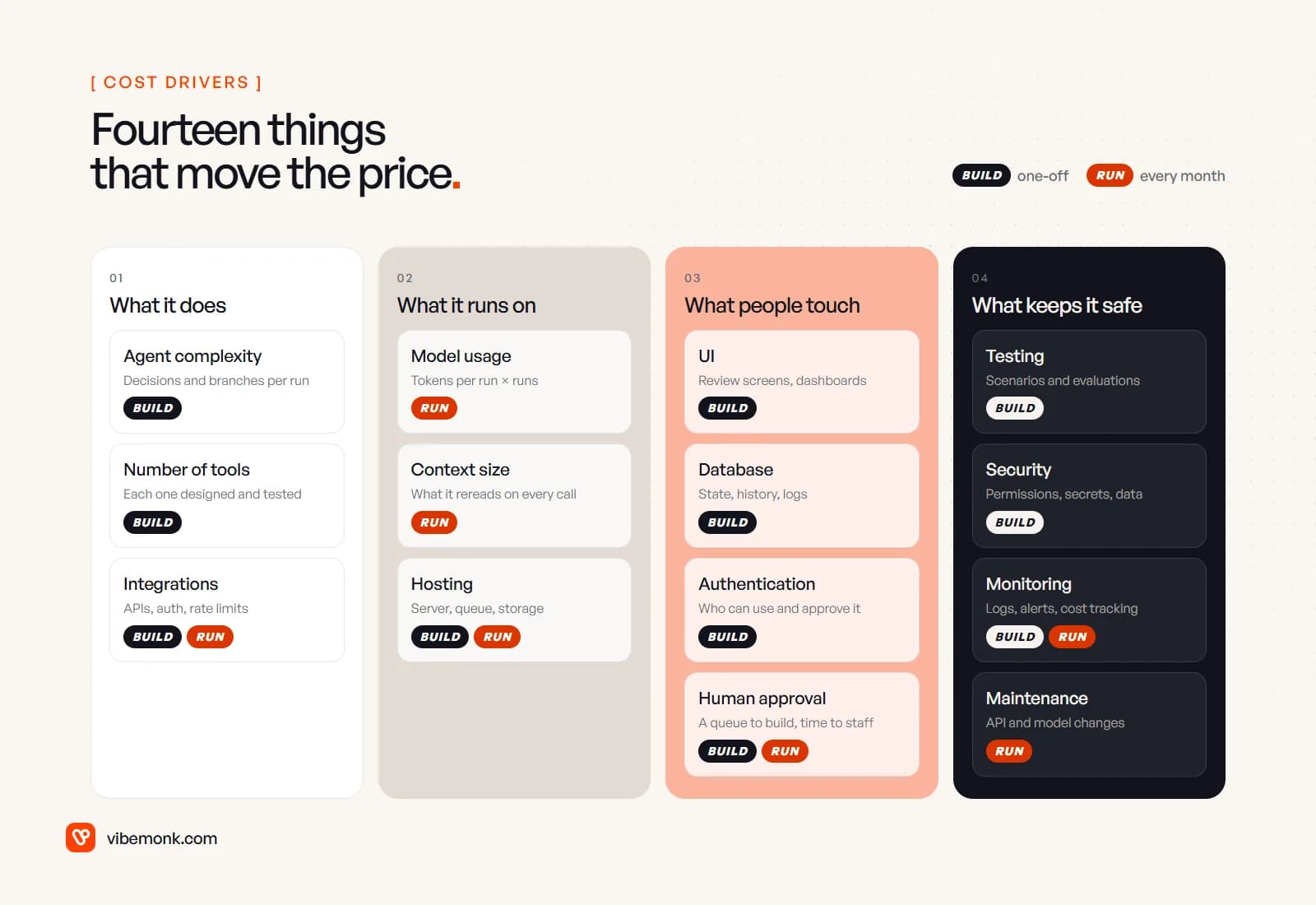
What the agent does.
- Agent complexity. How many decisions it makes in one run, and how many branches those decisions open. An agent that classifies and drafts is simpler than one that looks something up, decides, and then looks up something else depending on the answer.
- Number of tools. Every action the agent can take is a tool someone writes: a function with a name, inputs, permissions and error handling. Anthropic notes that while building its own coding agent, the team "spent more time optimizing our tools than the overall prompt." Each tool adds its own design, permissions and tests. Our guide to AI agent tool calling shows what each one involves.
- Integrations. The systems behind the tools. A modern CRM with a clean API is quick. An old system with no API, odd authentication or tight rate limits can be most of the project, and it keeps costing when the vendor changes something.
What it runs on.
- Model usage. You pay the model provider per token, every run. The worked example below shows how much the choice of model moves this.
- Context size. An agent re-reads its instructions, tool definitions and everything gathered so far on every call. Large documents or long histories multiply the input bill.
- Hosting. A server or serverless functions, a queue for jobs, storage for files. Usually modest, but it is a monthly line.
What people touch.
- UI. An agent that posts to Slack needs no interface. One whose work is reviewed by a team needs screens: a queue, a detail view, approve and edit buttons. That is ordinary web software and is priced like it.
- Database. Somewhere to keep each run's state, history and decisions, so you can answer "why did it do that?" a month later.
- Authentication. Who may use it, who may approve, and what each role can see. Trivial for an internal tool with one user, real work for something customers log in to.
- Human approval. A step where a person signs off before the agent acts. It costs once to build and again every month in the time of whoever reviews. Designing the approval step covers what that screen needs.
What keeps it safe.
- Testing. A fixed workflow can be tested path by path. An agent can take paths nobody wrote down, so it needs a set of test scenarios run against every change of prompt, tool or model.
- Security. Narrow permissions per tool, secrets kept out of prompts, care with what customer data goes to the model.
- Monitoring. Logs of each step, alerts when runs fail, and a running total of model spend.
- Maintenance. APIs change, and models are retired: Anthropic's own pricing page lists several earlier Claude models as retired. Someone has to move the agent to the next one and re-run the tests.
Five tiers, from a simple agent to a production system
The drivers combine into rough tiers. These are conceptual, not price bands: they describe what is being built, so you can see which one your idea sits in and what would push it up.
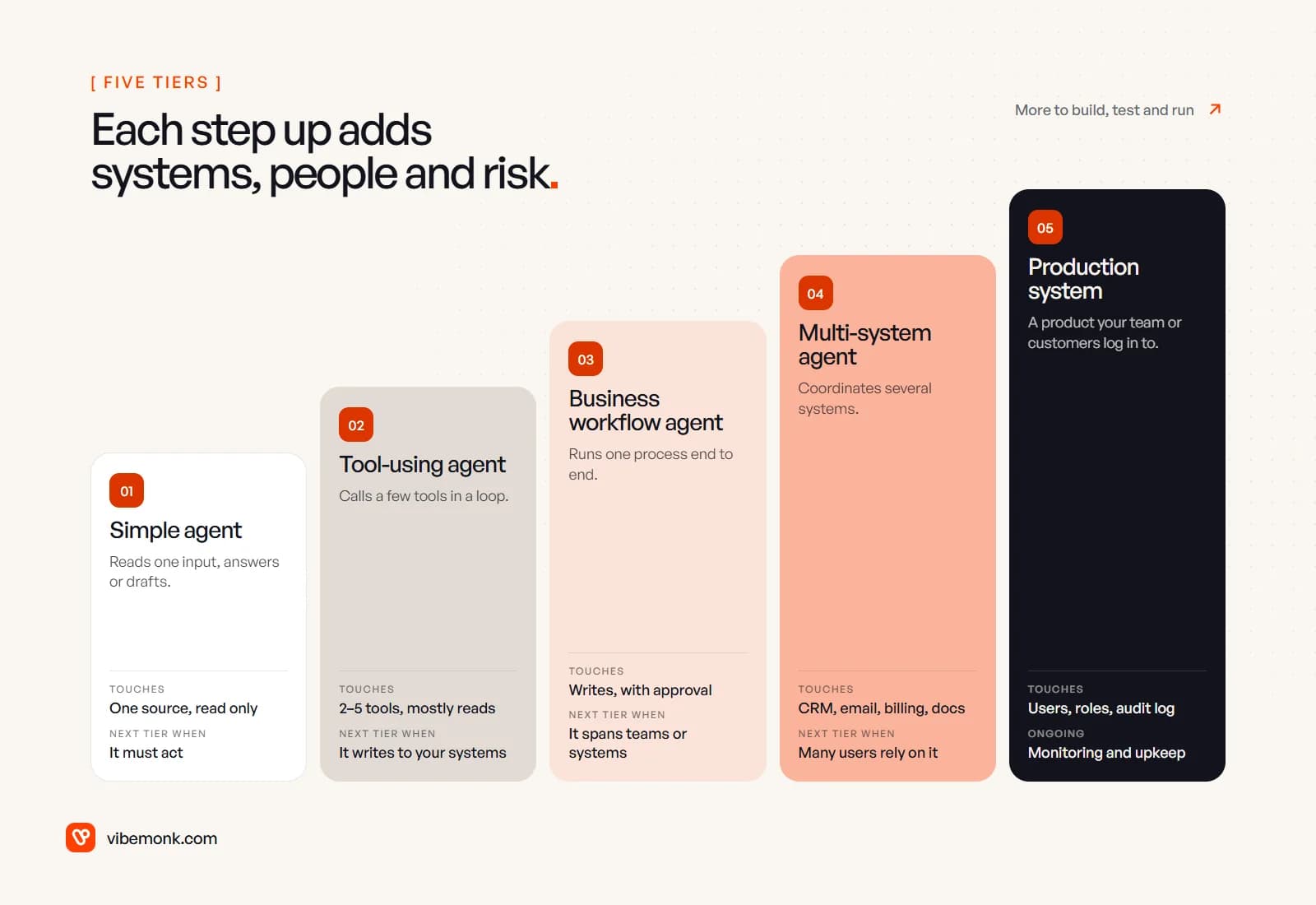
| Tier | What it does | What gets built | Moves up a tier when |
|---|---|---|---|
| 1. Simple agent | Reads one input and answers or drafts | A prompt, one model call or a short loop, output to email or Slack | It needs to act, not just draft |
| 2. Tool-using agent | Calls a handful of tools in a loop, mostly to look things up | Two to five tools, error handling, run logs | It writes to your systems |
| 3. Business workflow agent | Runs one process end to end, writing to your systems with approval | Write tools with permissions, an approval step, a test set, monitoring | The process spans several teams or systems |
| 4. Multi-system agent | Coordinates CRM, email, billing, documents | Several integrations, state across steps, a review screen, retries that do not duplicate work | Many people, or customers, rely on it daily |
| 5. Production system | A product people log in to, with the agent inside | Users and roles, a database, an audit log, dashboards, hosting built for uptime | It does not; from here the cost is running and improving it |
Two things are worth noticing. First, the model is roughly the same at every tier. What grows is the software around it. Second, the jump from tier 2 to tier 3 is usually the biggest step in risk, because it is the first time the agent changes something in your business. That is where approval, permissions and testing stop being optional. Our walkthrough of how to build an AI agent that takes actions shows that work in detail.
For a sense of what tier 5 contains, uContents, a social publishing platform we built, has an AI studio agent and an MCP server behind which sit 36 tools, and the agent asks for approval before anything that costs credits or changes data. That is a product, not an add-on, and it is scoped and priced as one.
What model usage costs: a worked example
Model usage is the run cost people ask about first, so here is the arithmetic, using Anthropic's published API prices per million tokens: Claude Haiku 5.5 at $0.10 input and $0.50 output (for prompts up to 100,000 tokens), Claude Sonnet 5.5 at $2 and $10, Claude Opus 5.5 at $4 and $20. The token counts are assumptions for illustration.
Say one agent run makes 6 model calls, each reading 8,000 input tokens and writing 400 output tokens. That is 48,000 input and 2,400 output tokens a run.
- Sonnet 5.5: 48,000 × $2 ÷ 1,000,000 = $0.096, plus 2,400 × $10 ÷ 1,000,000 = $0.024. About $0.12 a run, or $120 for 1,000 runs a month.
- Haiku 5.5: $0.0048 + $0.0012 = about $0.006 a run, or $6 a month.
- Opus 5.5: $0.192 + $0.048 = $0.24 a run, or $240 a month.
- Sonnet 5.5 with a bigger context, 30,000 input tokens a call: 180,000 × $2 ÷ 1,000,000 = $0.36, plus the same $0.024. About $0.38 a run, or $384 a month.
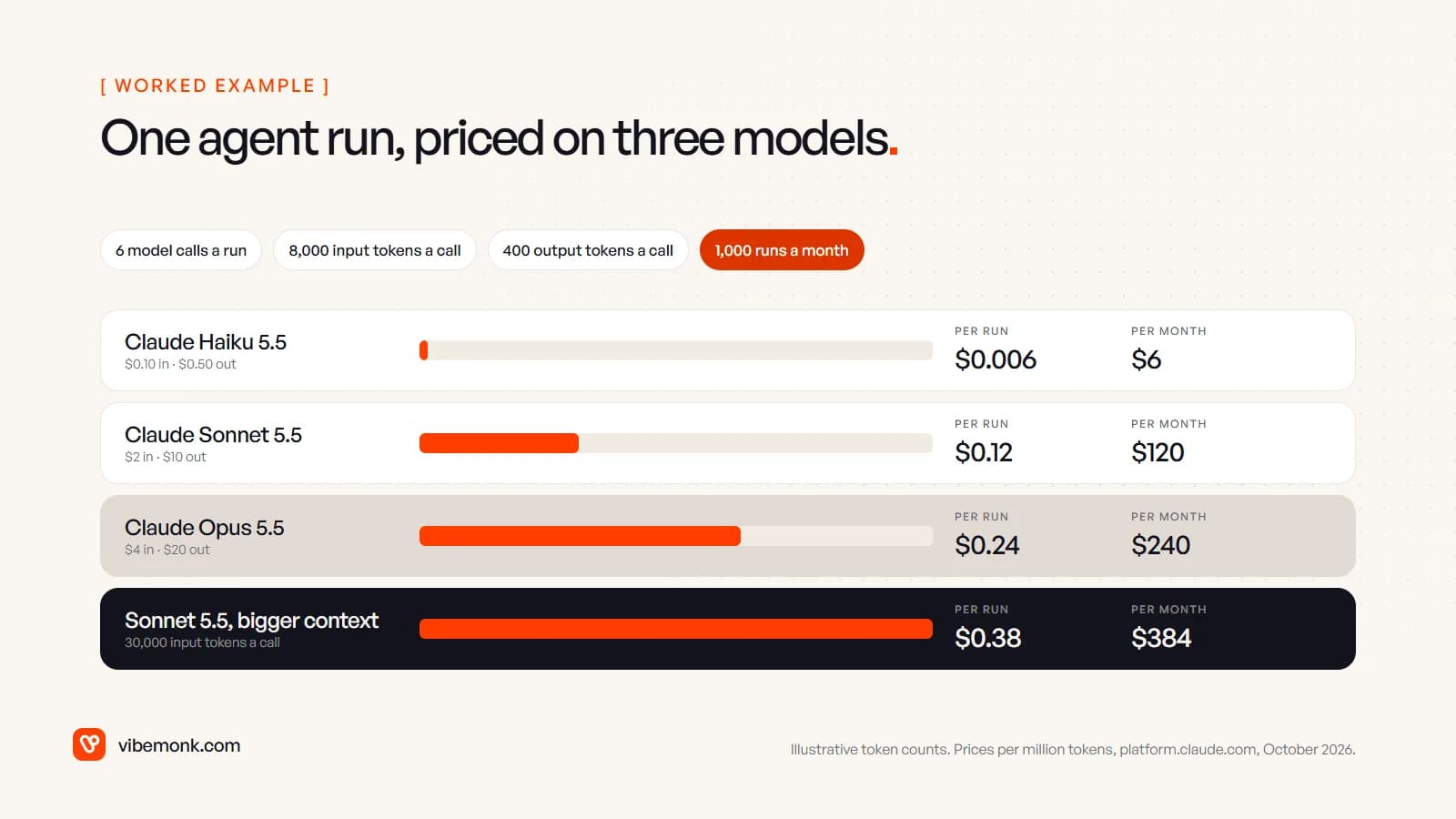
The spread is the point. The same run costs forty times more on one model than another, and growing the context from 8,000 to 30,000 tokens a call more than triples the bill on the same model. Two published levers bring it down: prompt caching, where repeated input read from the cache is billed at 5% of the normal input price on Sonnet 5.5 and Opus 5.5, and the Batch API, which halves prices for work that does not need an answer straight away. Both are on the same pricing page.
Also notice the scale. At these volumes the model bill is often smaller than the time a person spends reviewing the agent's work. The run cost that surprises people is rarely tokens; it is the approval queue and the upkeep.
The costs that are easy to leave out
Quotes are usually compared on build price. These are the lines that make two similar-looking quotes very different, or that turn up after launch:
- Test scenarios. Without a fixed set of cases to run after every change, nobody can safely change the prompt, add a tool or switch models. Ask whether the quote includes them.
- The review screen. If a person approves the agent's actions, they need somewhere to do it with the context in front of them. A Slack button can work for low volumes; a team reviewing dozens a day needs a proper queue.
- Failure handling. What happens when the CRM is down mid-run, or the model returns something malformed. Retries that do not send the same email twice take deliberate work.
- Cost tracking. A running total of model spend per run and per day, with a ceiling. Without it, a loop that misbehaves overnight is found on the invoice.
- Upkeep. Integrations break when vendors change APIs, and models get retired. Budget for someone to keep it working, monthly, from the start.
What Vibemonk charges to start
These are our own starting prices from our pricing page, not a statement about what the market charges. Every project gets a written scope and a fixed quote before work starts, and the price only changes if the scope does.
| Package | Starting at | Typical delivery | Where agent work usually fits |
|---|---|---|---|
| AI Workflow | $699 | 1–2 weeks | Tiers 1 and 2: model integration, multi-system logic, tested and deployed |
| Custom Tool | $1,499 | 2–4 weeks | Tier 3 when it needs its own screens, such as an internal AI tool or review dashboard |
| MVP / Custom System | $2,999 | 3–6+ weeks | Tiers 4 and 5: multi-workflow systems and AI agent platforms |
| Care (optional) | $299 / month | Ongoing | Bug fixes, monitoring, dependency updates and API maintenance after launch |
The mapping is a guide, not a rule. A tier 2 agent that has to reach an old system with no API can cost more than a tier 3 agent on clean, modern tools. That is why the quote comes after scoping, and why the model usage itself is a separate running cost on top of any build price. If you are weighing a ready-made platform instead, what AI agent platforms do and where they stop compares the trade-offs.
How to estimate your own before asking for a quote
You can place your project in a tier in an afternoon, and you will get a better quote for it. Write down three things.
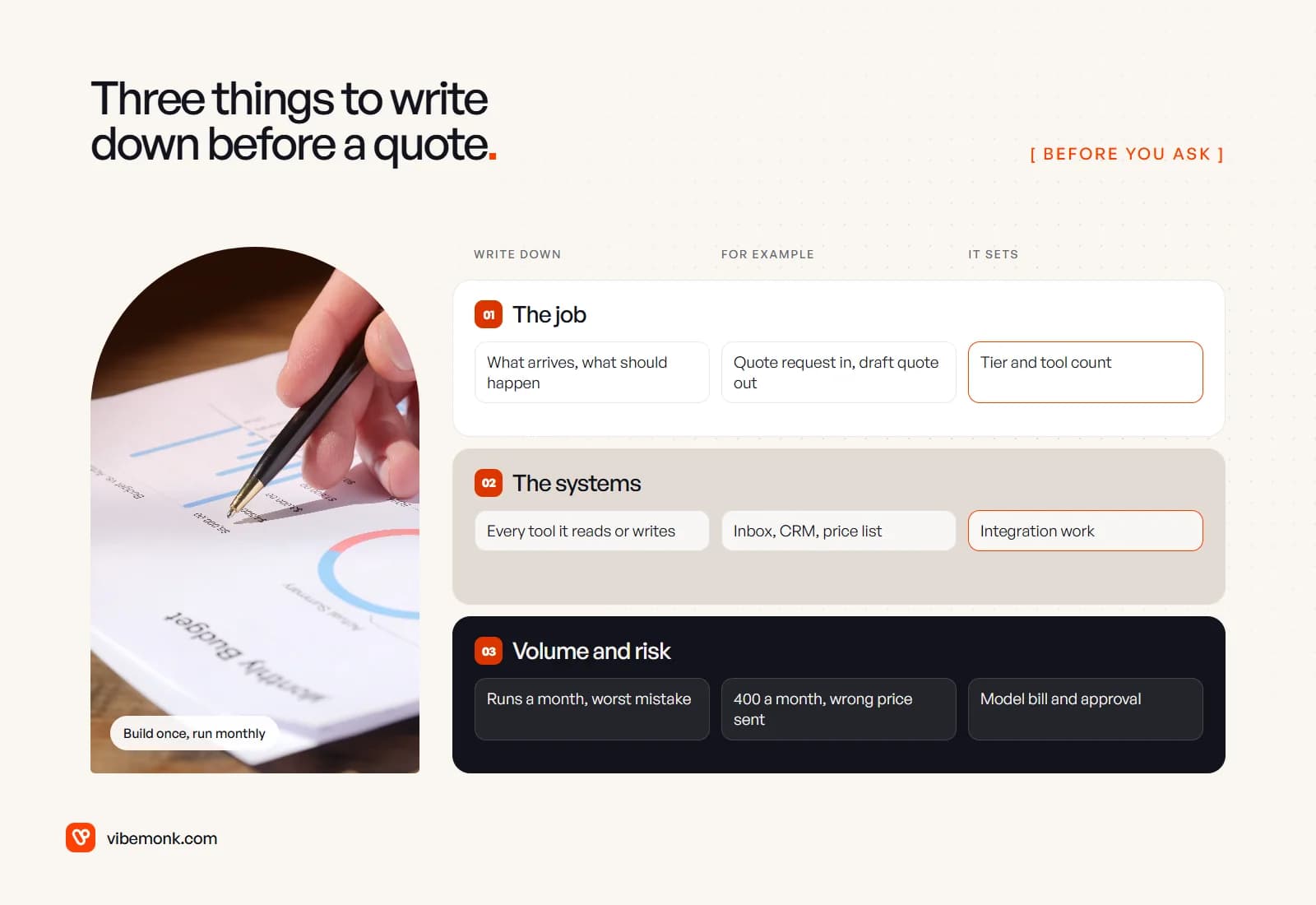
- The job, in one sentence of input and output. "A quote request arrives by email; a draft quote is waiting for approval in the CRM." If you cannot write that sentence, the first piece of work is defining the process, not building the agent.
- Every system it reads or writes. List each one and whether the agent only reads it or changes it. The count of write access is the clearest single signal of tier.
- Volume and the worst mistake. Roughly how many runs a month, and what the costliest wrong action would be. Volume sets the model bill; the worst mistake decides where a person has to approve.
With those three answers, run the arithmetic from the worked example on your own volumes, pick the tier the table points to, and ask anyone quoting you which of the five easily-forgotten costs their price includes.
If you have a specific workflow in mind, our discovery work maps how it runs today and turns it into a written scope with a fixed price. The agents themselves are built under Automate, around how your business actually works rather than how a template assumes it does.