Writing9 min readShimanto
AI Agents in 2026: What Businesses Should Automate First
AI agents 2026 guide: what to automate first, what to leave for later, and a yes/no scorecard to rank your workflows by volume, risk and access.
- Grow
Start with work that happens often, follows the same steps, arrives digitally and can be checked, where a wrong move is cheap to undo and a person can approve anything that matters. In practice that means triaging inbound email and enquiries, looking up order or account status, pulling fields out of documents, and drafting replies and follow-ups for someone to send. Leave hiring, credit, pricing exceptions and anything with no clear owner, poor data or no way to measure success for later, or for people. AI agents in 2026 can reach more of your systems than they could a year ago. That makes picking the right first job more important, not less.
Below: what has changed this year, the order to hand work over in, the eight signs of a good candidate and the six signs to wait, and a yes/no scorecard you can run on your own list.
What changed for AI agents in 2026, and what did not
Two things changed. Connecting a model to business tools has become routine: the Model Context Protocol and the tool-calling features in the main model APIs mean an agent can read a CRM, search an inbox or update a ticket without a custom bridge for every system. Vendors have also put "agent" on most of their products, whether or not it fits.
What did not change is what makes a project succeed. Gartner predicted in June 2025 that over 40% of agentic AI projects will be cancelled by the end of 2027, because of escalating costs, unclear business value or inadequate risk controls. The same release estimated that only about 130 of the thousands of vendors selling "agentic AI" offer the real thing, and called most current projects "early stage experiments or proof of concepts that are mostly driven by hype and are often misapplied".
None of those three failure reasons is about how clever the model is. Cost, value and risk controls are all settled when you choose the task. The vendors' own engineering guides say the same. Anthropic recommends "finding the simplest solution possible, and only increasing complexity when needed" (Building effective agents). OpenAI's practical guide to building agents says customers "typically achieve greater success with an incremental approach" and ends with "Start small, validate with real users, and grow capabilities over time."
So the useful question for 2026 is not whether to use agents. It is which job goes first, and how much the system is allowed to do on day one.
Hand over reading first and deciding last
The order in which you hand work to an agent matters as much as which work you choose. Sort tasks by what the system is allowed to do, not by department:
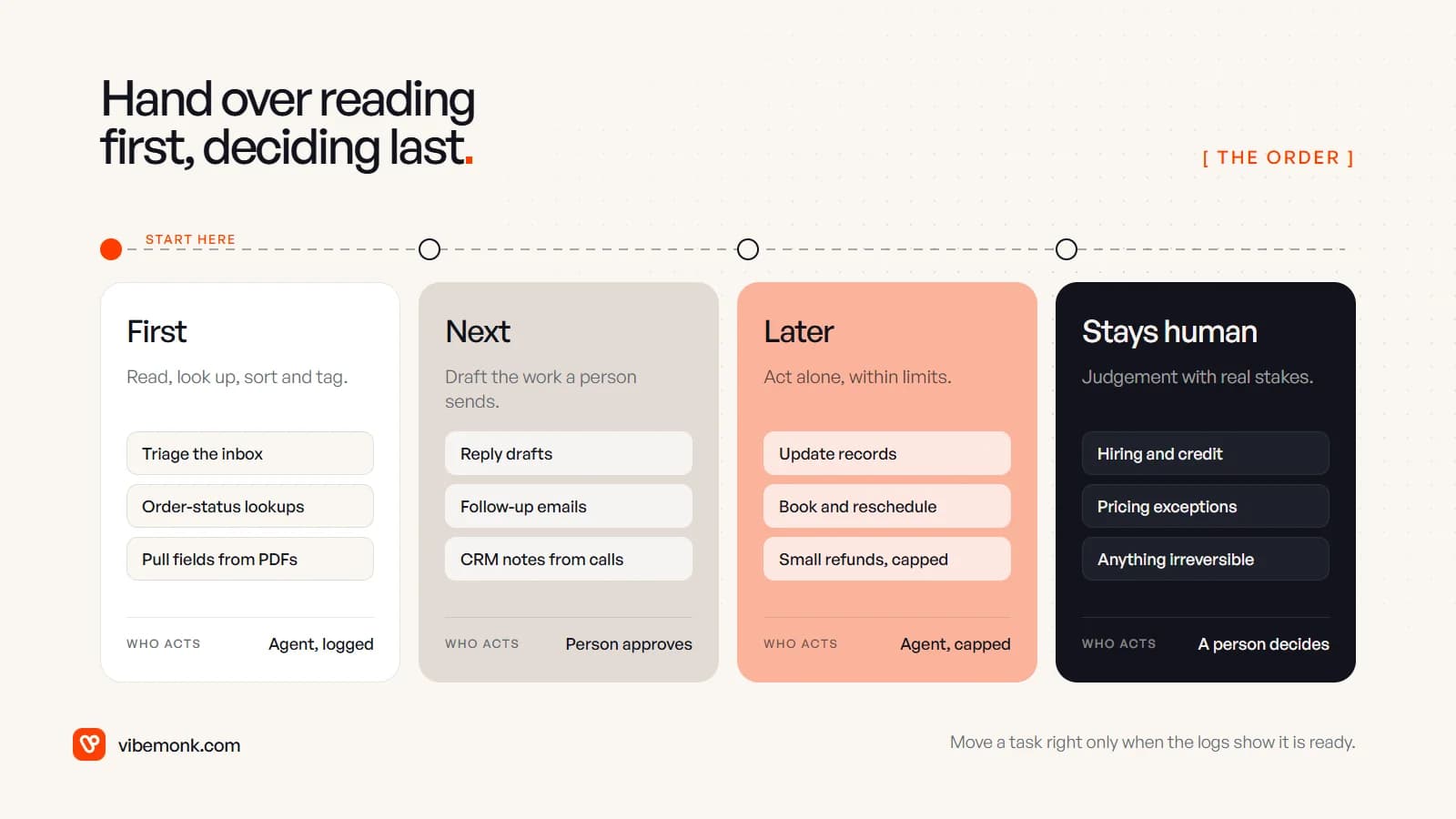
- First: read, look up, sort and tag. The agent triages a shared inbox, answers "where is my order?" from the order system, or pulls invoice fields from PDFs. It changes nothing important. A mistake costs a re-tag.
- Next: draft the work a person sends. Replies, follow-up emails, CRM notes from a call, a first-pass quote. A person reads and presses send. This is where most of the time saved comes from.
- Later: act alone, within limits. Updating records, booking and rescheduling, small refunds under a cap. The agent acts by itself, every action is logged and someone samples the log.
- Stays human: judgement with real stakes. Who gets hired or credit, pricing exceptions, anything that cannot be undone. The agent can gather the facts and lay them out. A person decides.
OpenAI's guide puts the boundary in the same place. It names "high-risk actions", meaning ones that are "sensitive, irreversible, or have high stakes", as a trigger for human oversight "until confidence in the agent's reliability grows", with cancelling orders, authorising large refunds and making payments as examples. It also suggests rating every tool the agent can use as low, medium or high risk, based on read-only versus write access, reversibility, account permissions and financial impact.
A task moves one column to the right when the run logs show it is ready, not when the demo looks good. That is how the products we build tend to work as well. The studio agent in uContents asks for approval before anything that costs credits or changes data. In GrowthDesk, the AI suggests replies and negotiation advice, and a deal outside its pricing rules waits for someone with the authority to approve it.
If a task never needs anything beyond the first two columns, it may not need an agent at all. A fixed workflow with one AI step is often enough; do you need an AI agent? walks through that test.
Eight signs of a good first candidate
A good first job has all or most of these. Each one makes the agent cheaper to build, easier to check, or safer to run.
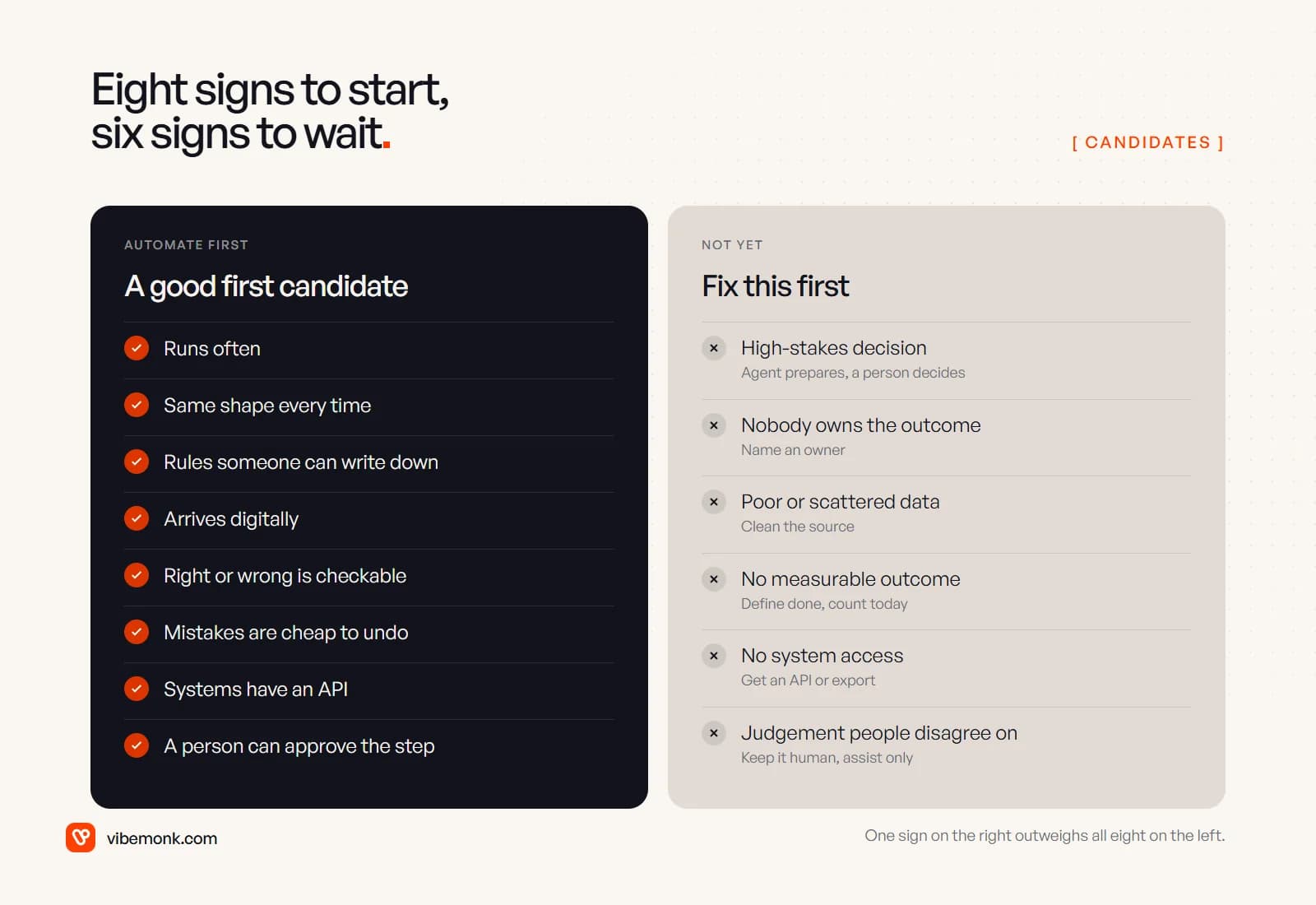
| Sign | Why it matters | Quick test |
|---|---|---|
| High volume | Time saved is per run, so frequency pays for the build | Count last month's runs in the inbox or system |
| Repetitive | Exceptions are where agents go wrong | How many runs out of ten need something unusual? |
| Clear rules and context | The agent can only follow what someone wrote down | Can the person doing it write the steps on one page? |
| Digital inputs | Paper and phone calls need another step before anything can read them | Does it arrive as an email, form, file or record? |
| Measurable output | You cannot improve, or justify, what you cannot check | Is there a right answer, and do you know today's time per run? |
| Low-risk actions | Cheap mistakes let you learn in production | What does the worst realistic error cost, and can it be undone? |
| Existing APIs or integrations | Integration is most of the build | Does every system involved have an API or a ready connector? |
| Human approval possible | A checkpoint lets you automate more, sooner | Is there a natural moment to review before it counts? |
Anthropic's guide sums up the pattern: the agent uses that work best tend to "have clear success criteria, enable feedback loops, and integrate meaningful human oversight". Customer support and coding are its two examples. Both have a checkable result and a person nearby.
Two of the signs carry most of the weight. Measurable output decides whether you will ever know the project worked. Existing integrations decide most of what it costs, because every action an agent can take is a tool someone has to write and secure. Our post on AI agent tool calling shows what that work involves.
Six signs a task should wait
Any one of these is enough to move a task down the list, however well it scores on the other eight. Each one has a fix that comes before the agent.
- High-risk decisions. Hiring, credit, medical or legal outcomes, large payments. A model can be wrong in ways that are hard to explain afterwards, and in many places the law limits fully automated decisions about people. Let the agent gather and summarise. A person decides. When not to use AI covers the legal side.
- Ambiguous responsibility. If nobody owns the process today, nobody will own the agent's mistakes. Name an owner who reads the logs and handles the exceptions before anything is built.
- Poor data. Duplicate customers, prices in three spreadsheets, a CRM half filled in. An agent acting on bad records makes bad decisions faster. Clean the source first. That project often pays for itself.
- No measurable outcome. "Make sales more proactive" is not a task. If you cannot say what a correct result looks like and how often it happens today, you cannot test the agent or show it was worth building.
- No system access. Data in a desktop tool with no API, or only on a screen someone clicks through. Get an export, an API or a better system in place first, or budget for that work as the real first project.
- Work that needs human judgement. Negotiating with a key account, handling a complaint that could become a legal matter, deciding on a supplier. Where experienced people would disagree about the right answer, an agent should assist, not act. Human-in-the-loop AI covers how to design that split so the reviewer is not just rubber-stamping.
What usually comes first, team by team
Put the two lists together and the same kinds of job keep coming out on top. These are typical candidates, not results from a specific business. Your volumes decide which one is yours.
| Team | Typical first job | What the agent does | Where a person sits |
|---|---|---|---|
| Sales | Inbound enquiry triage | Reads the enquiry, enriches it, scores fit, creates the CRM record, drafts a reply | Approves the reply; owns qualified leads |
| Support | Ticket triage and status questions | Classifies, routes, answers "where is my order?" from the order system | Handles anything outside the known categories |
| Finance | Supplier invoice intake | Extracts fields, matches to purchase orders, queues mismatches | Approves payment; resolves mismatches |
| Operations | Notes and records upkeep | Turns call notes into CRM updates, flags stale records | Spot-checks the log weekly |
The detail for each is in our posts on AI lead qualification, AI support ticket triage and AI document processing.
What tends to come later: pricing and discount decisions, anything that sends money out without a cap, and "an agent to run our marketing". The last one fails the scorecard on clarity and measurability before risk even comes up.
A quick scorecard for AI agents in 2026
Run this on each candidate on your list. It takes a few minutes per workflow, if the person who does the work answers the questions.
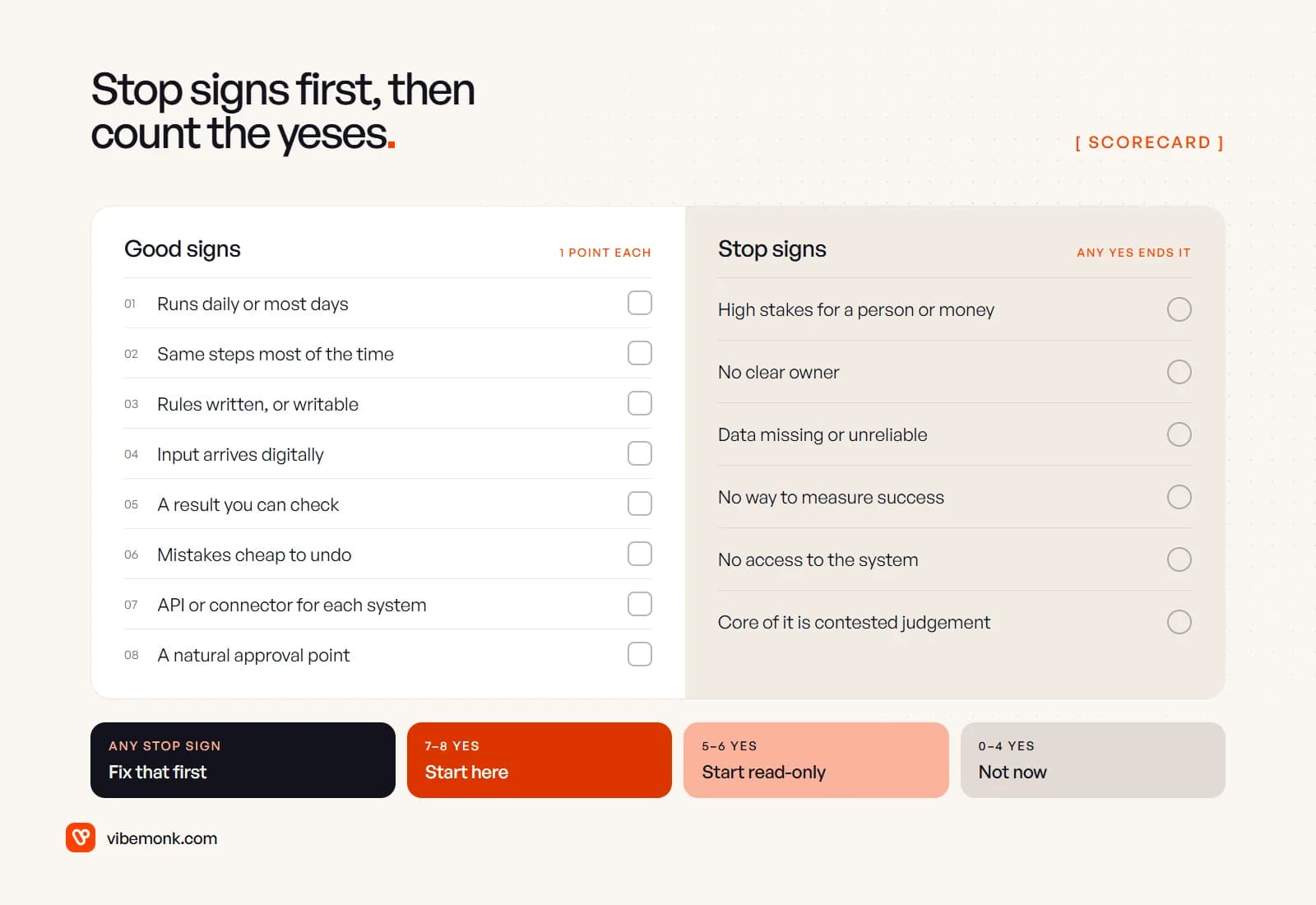
Step 1: check the stop signs. Answer yes or no to each of the six. Any yes means this is not your first project. Write down the fix (name an owner, clean the data, get API access) and move on to the next candidate.
Step 2: count the good signs. One point for each of the eight that is clearly true today. "It could be, once we tidy up" counts as no.
Step 3: read the total. Our rule of thumb:
| Yes count | What to do |
|---|---|
| 7–8 | Start here. Build it at the "draft for approval" stage, with a log of every run. |
| 5–6 | Start read-only (triage, lookup, extraction), and fix the missing signs before the agent writes anything. |
| 0–4 | Not now. A checklist, a better form or a plain rule will do more for less. |
If two candidates tie, pick the one with the larger baseline. Here is a worked example with assumed numbers: an enquiry inbox that gets 150 messages a month at five minutes each is 750 minutes, or 12.5 hours a month. Supplier invoices at 60 a month and eight minutes each come to 480 minutes, or 8 hours. Both might score 7, but the enquiries carry more time, and a drafted reply is cheaper to get wrong than a payment, so they go first.
Write the baseline down before you build. Without it you cannot tell in two months whether the agent is saving anything. To set it against the build and running costs, our guide to AI automation cost shows how to estimate both.
What to do with your shortlist
Pick the top-scoring candidate and build only that one. Start it at the most cautious stage it allows, give it a named owner and a log, and give it a few weeks of real runs before you consider moving it a column to the right. The second agent will be faster to build, because the integrations, logging and approval step will already exist.
If the scorecard keeps hitting the same stop sign, such as no API, scattered data or nobody owning the process, the first project is not an agent. That is what discovery and scoping is for: mapping how the work actually runs and deciding what to automate, what to build and what to stop. When a candidate passes, our AI agents and automation work covers building it, with the approval steps and logs it needs from the start.